
In this article
The Oura Ring 5 is the fifth generation of Oura's smart ring: a titanium piece with no screen or vibrations that records heart rate, heart rate variability (HRV), skin temperature, blood oxygen saturation and movement, and summarises them in three daily scores (Sleep, Readiness and Activity). Its main change from the Oura Ring 4 is not a new feature but size: according to Oura it is 40% smaller. Its main drawback remains the same as for the whole brand: the full app runs on a subscription.
This review brings together the specifications published by Oura, the available validation studies (with their limits) and reviews from specialist media, attributed to whoever signs them. It is not based on hands-on testing of the product. A consumer ring is useful for observing trends in your own body; it does not diagnose anything.
Two starting points. The first: Oura presented the Ring 5 on 28 May 2026, according to its launch post, and the press places the start of shipments on 4 June (for example, Trending Topics). The second: on Amazon.es each size and each finish has its own listing, and the button on this page leads to one of them (Silver finish, size 11); from the listing you can change size and colour. Because the Ring 5's sizes do not match the Ring 4's, it is worth settling on your size before buying, something explained further down.
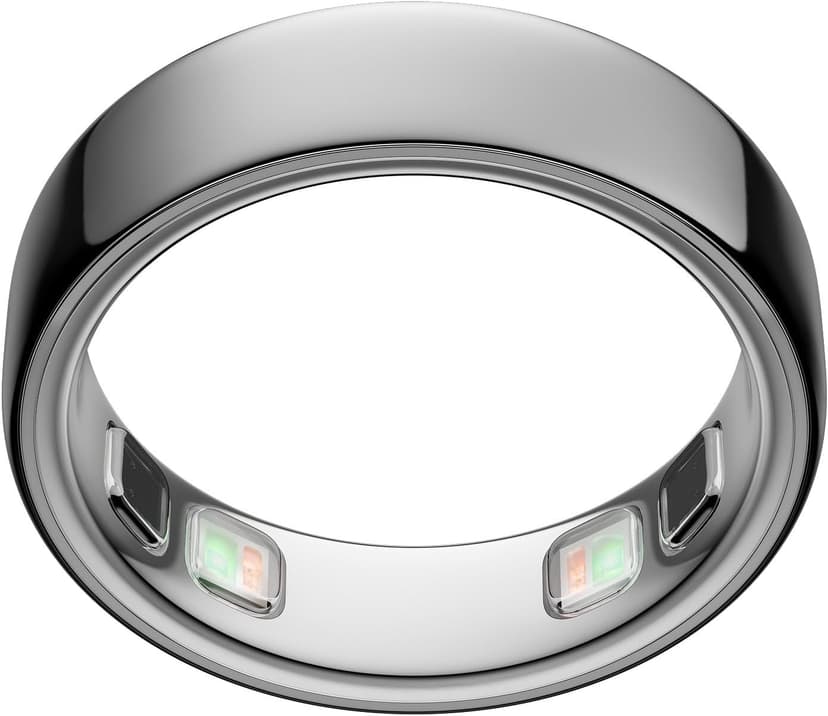
Oura Ring 5
Titanium ring 6.09 mm wide that tracks sleep, HRV, temperature and SpO2, with a subscription-based app.
Pros
- •More discreet than the Ring 4: 6.09 mm wide, 2.28 mm thick and from 2 g according to Oura, versus the Ring 4’s 7.9 mm and about 2.88 mm; several reviews agree it is less noticeable.
- •Official battery life of 6 to 9 days; in the attributed review tests, between roughly a week and a little over seven days in a size 11.
- •IP68 water resistance down to 100 m and six finishes, all titanium.
- •Same app features as the Ring 4 with an active membership, and part of the new software also reaches rings from earlier generations.
Cons
- •No published independent validation of the Ring 5: the accuracy improvements (12% more accuracy in overnight HRV, according to Oura) are the company’s own figures with no methodology.
- •The full app requires a membership: without it you only see three scores, the battery and little else, and the fee cannot be paused.
- •Fewer sizes than the Ring 4 (6 to 13, versus 4 to 15) and different sizing: the Ring 4 kit does not work.
- •Pulse sensors during barbell or dumbbell training are unreliable according to one review, and live workout data depends on an external sensor.
What the Oura Ring 5 measures
According to Oura's official product page, the ring combines red and infrared LEDs for blood oxygen saturation, green and infrared LEDs for heart rate, HRV and respiratory rate (continuously), a digital temperature sensor and an accelerometer. It weighs from 2 g depending on size, is titanium inside and out, is water resistant to 100 m with IP68 certification and charges in about 80 minutes. In the box, according to the same page, come the ring, a size-specific charger and a USB-C cable.
With those signals, the app calculates the three daily scores. It matters to know what they are: proprietary algorithms whose exact weighting cannot be audited, and values relative to your own baseline from the last few weeks. A Readiness of 70 is not a physical unit; it is a signal of how you are doing relative to your normal. That is why the ring gains value with weeks of use, not on the first night.
Temperature deserves a clarification: the sensor measures the skin of the finger and its deviations from your pattern, not core body temperature. It is useful for seeing relative changes, not as a clinical thermometer. And SpO2 is an indicative estimate, not that of a medical pulse oximeter. As BGR reminds readers in its review, Oura is not a medical device.
Ring 5 or Ring 4: what really changes
This is the question almost every buyer asks. The press's short answer is that the Ring 5 is mainly an improvement in comfort and battery, not a leap in what is measured. The table summarises what Oura publishes on its comparison page for both models:
| | Oura Ring 5 | Oura Ring 4 | | :- | :- | :- | | Width | 6.09 mm | 7.9 mm | | Thickness | 2.28 mm | About 2.88 mm | | Sensor dome height | 0.7 mm | 0.3 mm | | Photodetectors | 2 | 3 | | Internal memory | Up to three days of data | Up to seven days of data | | Sizes | 6 to 13 | 4 to 15 | | Typical battery | 6 to 9 days | 5 to 8 days (per TechCrunch) |
The Ring 4's battery life does not appear on that page: the 5 to 8 days figure comes from TechCrunch's review, which does not say where it takes it from. According to that same review, the Ring 5 weighs between 2 and 2.69 g, versus 3.3 to 5.2 g for the Ring 4.
What really changes
- Size and comfort. This is the most obvious change and the one reviews repeat most. Aisha Malik, at TechCrunch, writes that it feels clearly better than the Ring 4, that you forget you are wearing it and that it is more comfortable for sleeping than a watch. At Android Authority, Kaitlyn Cimino describes it as noticeably less bulky than previous Oura models.
- Battery. Oura states 6 to 9 days. The reviews read agree that it improves, although it does not always reach the ceiling: Alex Harrington, at Newsweek, went from a full charge to about 7% in a little over seven days with a size 11; Christian de Looper, at BGR, usually gets to a week and did not reach nine days.
- Sensor design. Oura explains in its technical post that it moved the LEDs and photodiodes closer to the skin, and states 12 signal paths. Newsweek reports that there used to be 18 and that Oura compensates with brighter sensors. Oura attributes to this redesign 12% more accuracy in the average user’s overnight HRV and a 24% improvement in heart rate signal quality during workouts, and publishes those figures without methodology.
- Finishes. Six finishes, all titanium with a PVD coating. The Ring 4 also had a ceramic version, which the Ring 5 does not offer according to Oura's finish listing.
What does not change
- The algorithms. BGR says the underlying algorithms are the same as the Ring 4’s.
- The fee. Same membership, as detailed below.
- Much of the software. Oura says the new features, such as Health Radar or GLP-1 Insights, will be available to members with Oura Ring Gen3 and later models. Athletech News adds that Ring 4 users will receive almost all of them by update.
Who each one makes sense for
- Ring 5: according to Athletech News, anyone buying their first ring, anyone coming from a Gen3 and anyone who found earlier models bulky; for anyone who already has a Ring 4 it recommends switching only if theirs feels cumbersome or catches during workouts. TechCrunch, for its part, sees it as a solid option for people who do not yet have a ring.
- Ring 4: anyone who already has it and whose fit is good: Android Authority sums it up by saying that, if you have it and like it, there is little reason to switch. Also anyone who needs a size outside the 6-13 range, or prefers ceramic, or finds the Ring 4 in good condition and is not bothered by the size.
Accuracy: what is validated and what is not
The honest answer is this: in the search carried out for this review, no independent study validating the Ring 5 was found. Everything Oura says about its greater accuracy (in its words, the most accurate Oura ring to date) comes from the company itself, with no published methodology. In the launch post, it also claims the pulse signal is up to 100 times stronger than that of wrist-worn devices, without citing any study. That post does not refer to clinical validation studies either.
What does exist is validation of earlier generations, which cannot simply be carried over to the Ring 5:
- A study published in Sensors in 2024 compared the Oura Ring Gen3 with the Fitbit Sense 2 and the Apple Watch Series 8 against polysomnography in 35 healthy adults over one night. The Gen3 reached a sensitivity of between 76.0 and 79.5% per sleep stage, a four-stage kappa agreement of 0.65 and a sensitivity of around 95% for telling sleep from wake. The caveats are important: a single night, healthy participants, a lab, funding from Oura and a lead author who sits on the company’s medical advisory board.
- A validation in Sleep Medicine (2024) of the Gen3 with 96 healthy Japanese participants and 421,045 30-second epochs against multi-night polysomnography reported per-stage accuracy of between 75.5% (light sleep) and 90.6% (REM). Three of the authors declare financial support from Oura Health Oy.
Neither uses the Ring 5, nor the Ring 4. What can be taken from them with caution: these devices tell sleep from wakefulness well and are less reliable at separating stages, so the figures for a particular night ("1 h 20 min of deep sleep") are estimates and what is useful is the trend over weeks. Nor is there evidence that wearing the ring improves sleep: it measures, and what you do with the data is another matter.
What the reviews say. These are short usage tests, not studies, and should be read as such:
- At Android Authority, Kaitlyn Cimino (16 July 2026) says that overnight heart rate and HRV closely matched her reference devices and that the sleep stages were among the most accurate she has compared. In workouts, the pulse was reliable when running, walking and hiking, but dropped when gripping the handle of a rowing machine.
- At Newsweek, Alex Harrington describes heart rate as reliable in most activities and on an indoor bike, but sometimes giving bad readings when walking and running, and suffering repeated dropouts when holding weights, which he attributes to the ring shifting on the hand. He also considers the VO2 max estimate hard to believe, although useful for seeing the trend. On sleep, he writes that the schedules were reliable.
- At BGR, Christian de Looper (8 September 2026) found consistent readings and a workout pulse close to that of an Apple Watch Ultra 2, but did not check the improvement percentages Oura states. He also considers the new Blood Pressure Signals and Nighttime Breathing features to be trend tools, not diagnoses, with little independent validation.
None of these reviews replaces a study with polysomnography or electrocardiogram. They give uneven results in activity: good on sleep and steady cardio according to Android Authority and BGR, with failures at Newsweek (bad readings when walking and running, pulse dropouts with weights), and none compares the Ring 5 with the Ring 4 using reference data. Nor is there any way of knowing whether the drop from 18 to 12 signal paths that Newsweek reports influences those differences.
Battery life: what Oura says and what the reviews report
Oura gives a battery life of 6 to 9 days depending on size, settings, activity and battery age, and about 80 minutes for a full charge. Its own communication is somewhat inconsistent: the launch post speaks of a week of battery in one section and of 6 to 9 days in another. The reasonable approach is to take 6 to 9 as the stated range and the ceiling as the best case.
The review measurements fall in the middle zone: a little over seven days down to about 7% battery (Newsweek, size 11); around a week, without reaching nine (BGR); and a ring charged to 75% during setup and close to 25% after five days of continuous use (TechCrunch). Aisha Malik notes that her test lasted about five days of continuous use and so she cannot assess long-term durability.
That is the missing data point. The first shipments are from June 2026, and in the reviews read there are no multi-month tests. At Newsweek the author says that a relative’s ring, more than a year old, lost a lot of battery and Oura replaced it under warranty; it is a personal anecdote, not a statistic, and it is not known which generation it was. The prudent course is to keep the receipt and check the seller’s warranty and return conditions.
There is also a design detail: according to Oura's comparison page, the Ring 5 stores up to three days of data in its internal memory, versus seven for the Ring 4. The page does not explain what that means in practice; in any case, it is worth bearing in mind if you often go days without opening the app.
Then there is charging: Oura sells a charging case separately which, according to its launch post, provides up to a month of battery and charges wirelessly. It is not in the box.
The subscription: the main decision
For many people this is where the purchase is decided. According to Oura's help centre, the membership costs €5.99 a month or €69.99 a year in the European Union. That page does not expressly mention the Ring 5; the US press (Athletech News, Newsweek, BGR) gives the same fee in dollars for this model, so there is no sign that it has changed. New members get a free month from when the ring is paired with the app, and the membership cannot be paused: you cancel it or keep it.
With an active membership, according to Oura, the following are unlocked: detailed sleep analysis, 24-hour heart rate, SpO2, daytime stress, advanced temperature, cardiovascular and metabolic health features, resilience, women’s health, periodic reports and integrations with third-party apps such as Strava. Without it, you only see the three daily scores (Sleep, Readiness and Activity), the battery level, the profile, settings and Explore content. Access to the API is lost, although data can be exported from the Membership Hub.
Practical consequences: the real cost of the ring is not just that of the buy button, because with the annual fee, three years add up to about €210 on top of the device; and without the fee little more than three numbers remains, so it is not a realistic way to use it. In reviews, the fee and the price are among the usual criticisms: BGR says it is hard to justify unless you want its extra features, and at Android Authority the upfront cost and the subscription appear among the cons, along with the charging case not being included, unlike those of RingConn and Ultrahuman.
Fit, sizes, materials and durability
Fit affects the quality of the readings: a loose ring measures worse, and your finger changes thickness with heat, food or exercise. Oura warns that the Ring 5’s sizing is slightly different from the Ring 4’s and advises using the Ring 5 sizing kit, which is not the same as the previous one. Sizes run from 6 to 13; TechCrunch reports that Oura is narrowing the range because small rings are harder to manufacture and that it is watching demand for the eliminated sizes. At Android Authority, the reviewer went from her usual size 5 to a 6 under the new sizing. Newsweek and BGR recommend wearing the plastic kit that Oura sends beforehand (a full day, according to Newsweek; several days, according to BGR) to decide on your size.
If your finger falls outside the 6 to 13 range, the Ring 5 simply does not exist for you. It is a real limitation compared with the Ring 4, and it can be worn on the index, middle or ring finger, according to Oura.
On materials, the six finishes are titanium with a PVD coating that, according to Oura in its technical post, significantly increases scratch resistance. Independent evidence is still scarce and uneven: at BGR the ring had no scratches after weeks of daily use, while Android Authority says it held up well on a hike with scrapes against rocks. That is an impression from use, not a resistance test, and titanium, however coated, is not scratch-proof. The Gold, Deep Rose, Stealth and Brushed Silver finishes cost more than Silver and Black, a purely cosmetic premium according to BGR.
On water: IP68 and 100 m. According to Oura's explanation, it withstands the sauna and the hot tub and is designed for everyday water and recreational water sports, not for deep diving. Oura warns that chlorine and salt water can wear it down if exposure is repeated or prolonged, and advises rinsing it with fresh water and drying it before putting it on the charging base.
Software news and what reaches Spain
The launch came with new features. According to Oura's announcement, Health Radar monitors cardiovascular and respiratory signals in the background, with Blood Pressure Signals and Nighttime Breathing; GLP-1 Insights shows the progress of people taking that type of medication alongside their Oura signals; and Counsel Health is an AI and physician care platform being tested in Oura Labs. Oura indicates availability only in the United States, the United Arab Emirates and India for Health Radar and GLP-1 Insights, and that page does not mention Spain or the European Union. Anyone buying in Spain should not count on them without first checking on Oura's website.
There is another nuance: those features are software and, according to Oura, also reach Gen3 and later models. They are not a reason to choose the Ring 5 over the Ring 4. And, as BGR points out, there is hardly any independent validation of Blood Pressure Signals and Nighttime Breathing. They are trend alerts that, if something is worrying, point to a consultation with a healthcare professional, not to a diagnosis.
Who it is not for
- Strength training and CrossFit. Newsweek describes heart rate dropouts when holding weights, and recalls that live measurement during workouts requires an external sensor (the author used a Polar H9): without it, the app shows little more than a stopwatch and, outdoors, GPS distance; in addition, exports to Strava omit the pulse. Anyone training for performance usually prefers a watch such as the Apple Watch Ultra 3, which gives real-time metrics during effort. Android Authority sums it up as a wellness tracker rather than a training one.
- Anyone who does not want a fee. If paying every month to see your own data bothers you, Oura’s model is not for you.
- Fingers outside the 6-13 range, or anyone who does not want to depend on a single sizing before buying.
- Anyone who needs medical data. It is not a medical device: it does not diagnose apnea, arrhythmias or fever.
Alternatives
The smart ring comparison sets the ring against its competitors, but it is written with the Ring 4 as the reference. Summarised by profile:
- No subscription. The Samsung Galaxy Ring requires no fee for its main features, but works only with Android phones, and in its review no published studies validating its measurements were found. It is the logical alternative for anyone who wants to avoid recurring payments, at the cost of the ecosystem. BGR agrees that, for Galaxy users, it makes more sense because it charges no fee.
- Recovery and strain. The Whoop 5.0 is a screenless band bought as part of a membership and focused more on training load and recovery than on night-time comfort. It makes sense if you train daily and do not mind wearing something on your wrist.
- Other rings with no fee. TechCrunch cites RingConn and Ultrahuman as rivals without a subscription, and Android Authority mentions them when comparing the charging case. On this site they have no review of their own, so they are not compared here. Anyone considering them should check the fee on their website and demand the same of them: validation studies on the specific model and a clear warranty.
- A multisport watch. Screen, GPS and metrics during exercise, in exchange for wearing it to sleep.
Verdict
The Ring 5 is the Oura ring that best suits anyone who wants to track sleep without feeling they are wearing anything. Its strength is comfort and a somewhat better battery than the previous generation; its weak point is that its accuracy still lacks independent validation, that the fee is mandatory to use it seriously and that there is as yet no published data on long-term durability. For anyone who already has a Ring 4 that fits well, it is a change in comfort, not in capabilities.
The score of 83 out of 100 weighs, in order of weight, accuracy (plausible given the track record of earlier generations and what the reviews say, but with no validation of its own and with improvement figures supplied only by the manufacturer), software and subscription (complete, conditional on the fee, with new features whose availability in Spain Oura does not confirm), battery life (better than before but not reaching the stated ceiling), comfort (its best card) and value for money (weighed down by the initial cost plus the recurring fee). It lands slightly above the Oura Ring 4 for comfort and battery, and does not go higher because of the lack of independent validation.
Before buying: first order the Ring 5 sizing kit and wear it for several days, at different times of day. It is a small cost compared with returning a ring that does not fit, and the Ring 4 kit is no use.
Veredicto Final del Experto
Oura Ring 5
Someone who prioritises sleep and night-time comfort, wants Oura’s most discreet ring and accepts the monthly fee.
Samsung Galaxy Ring
Someone who uses Android and does not want to pay a fee for the app.
Skip it if…
You do strength training, need a reliable pulse during workouts or reject the subscription.


