Best Compression Boots 2026: Comparison by Profile
In this article
People comparing pressotherapy boots usually ask three questions: what a pneumatic compression boot really achieves, what sets one model apart from another, and whether the investment is justified for their training level. This comparison answers all three with what can be documented: manufacturers' product pages, their safety documentation, a recent systematic review and what users say in forums. The site does not physically test products, and any figure that could not be verified is stated as such.
Here is the realistic expectation, before looking at models. The meta-analysis published in 2024 in Biology of Sport on intermittent pneumatic compression in athletes concludes that it offers, at most, moderate beneficial effects on the perception of muscle pain and discomfort, and it finds no significant improvement in muscle function. The authors themselves urge caution. The boots may make your legs feel better; there is no basis for saying they speed up recovery or improve next-day performance. Everything that follows starts from there.
Comparison table
The data in this table come from the site's reviews of each model and the sources they cite. The RecoveryAir PRO figures are from the retailer's spec sheet (Fleet Feet), not from an official Therabody page: the URLs for this model that we tried to open return an error.
| | Normatec 3 (Hyperice) | RecoveryAir PRO (Therabody) | | :- | :- | :- | | Pressure | 7 levels, from 40 to 110 mmHg (Hyperice product page) | From 20 to 100 mmHg, with per-chamber control (retailer's spec sheet) | | Zones or chambers | 5 zones with no gaps between them, plus ZoneBoost (Hyperice product page) | 4 chambers (a less firm data point: it rests on the JetBoots PRO Plus product page and on another retailer) | | Battery life | Up to 3 hours (Hyperice product page) | Up to 240 minutes (retailer's spec sheet) | | Weight | 3.2 lb, about 1.45 kg (Hyperice product page) | Control unit of 2.14 kg (retailer's spec sheet) | | Programs | No list of named modes; level, duration and ZoneBoost vary | 4 presets and a PRO free mode (retailer's spec sheet) | | Sizes | 3: short, standard and tall | 3: small, medium and large, by leg length | | App | Hyperice, over Bluetooth | Therabody, over Bluetooth, with savable routines (retailer's spec sheet) | | Fee | The product page mentions none | None appears in the product pages consulted | | Newest model | Normatec Premier, wireless (Hyperice press release, 2024) | JetBoots Prime and PRO Plus, wireless (Therabody website); we have not confirmed whether the RecoveryAir PRO has been discontinued |
The Normatec 3's sizes vary slightly by retailer. Neither manufacturer presents these products as medical devices in the documentation consulted.
What to expect from a compression boot
Intermittent pneumatic compression originated in clinical settings and has since moved into sport. A sleeve with air chambers inflates in sequence, from the foot to the thigh, and deflates in cycles. The mechanism manufacturers propose (more venous and lymphatic return, less heaviness) and the result measured in studies are different things.
The 2024 meta-analysis (Maia and colleagues) gathered 17 studies with 319 participants, 14 of them in the quantitative analysis. It observed a trivial to moderate effect on perceived pain and discomfort. The largest effect appeared at 48 hours, but without statistical significance; there were small, significant effects at 0-2 hours and at 96 hours. On muscle function, the benefit was trivial to small and not significant. Only six studies used a placebo condition, and since participants know whether they are wearing the boots, the risk of bias is evident. The authors describe the evidence as still embryonic.
Two practical consequences for comparing:
- The review studies the technology, not a brand. There is no support for claiming that one pair of boots works better than another, so the choice between models comes down to fit, comfort, app, battery life and availability, not to promises of efficacy.
- Better-feeling legs can be valuable for someone who accumulates a lot of volume. But it is a subjective sensation, and it is not the same as faster recovery.
Normatec 3: the best-known system, with a lighter unit
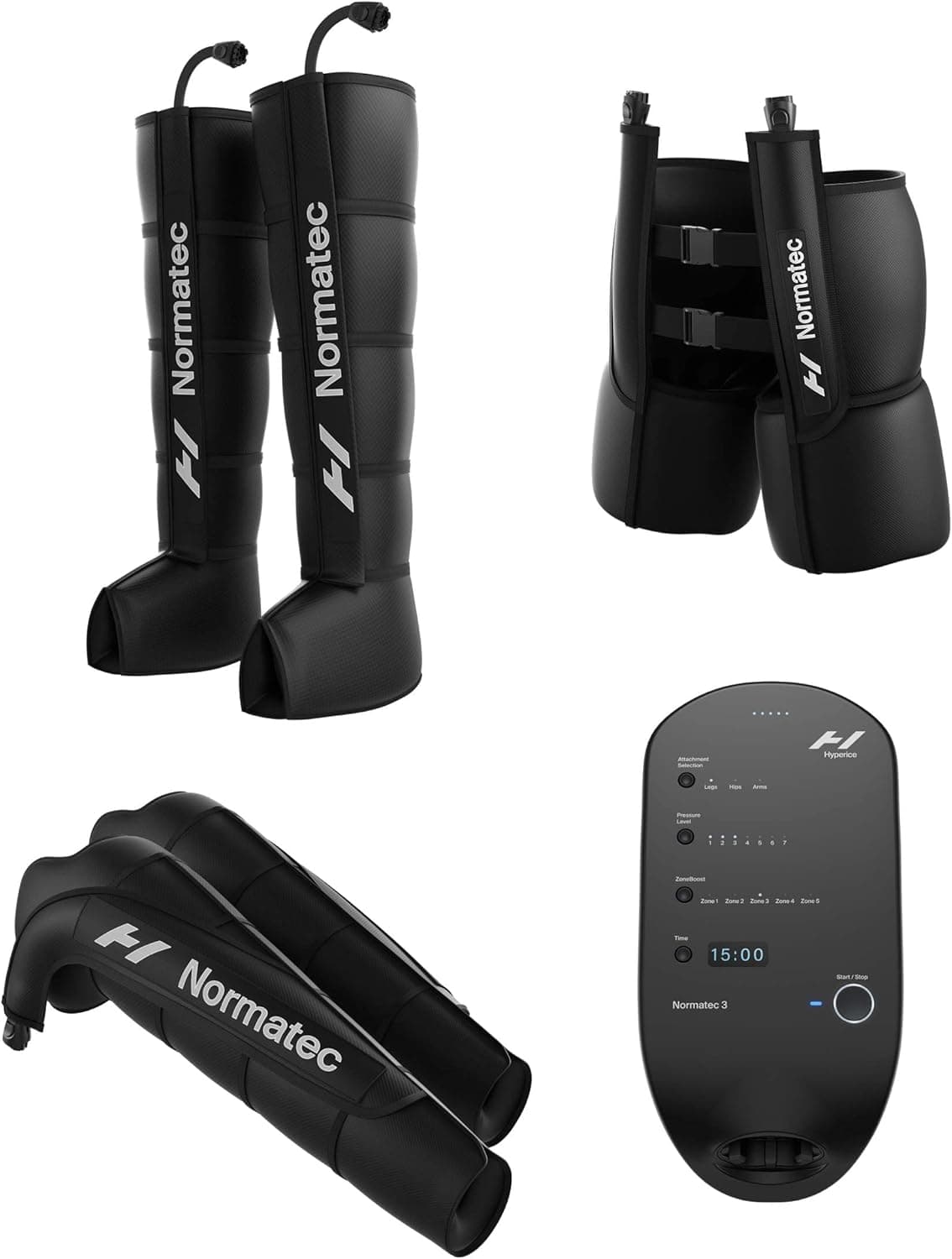
The Normatec 3 is the reference boot in cycling, running and strength circles. According to the Hyperice product page, it offers five compression zones with no gaps, seven pressure levels between 40 and 110 mmHg, ZoneBoost to reinforce a specific zone (the calf, for example), up to three hours of battery life and Bluetooth connection to the brand's app. Hyperice also describes it as compatible with airport security checks.
It is the model with the lighter unit of the two compared here (about 1.45 kg according to the product page) and the one with the simpler approach: few levels, an app that expands customization and no fee mentioned by the manufacturer. On the other hand, the pressure range starts higher than on the RecoveryAir PRO, which matters to anyone who wants very gentle sessions. There is still an external unit connected by a hose and the hum of a compressor.
In endurance-athlete forums, such as a Slowtwitch thread, opinions are split. Several users say their legs feel less heavy the next day and use the boots after long runs; others acknowledge that part of the benefit may be placebo. A recurring idea is that they are worth more to people who log many hours of training. These are opinions, not lab data, and those forums are biased toward people who have already paid for the product.
An important notice: in 2024 Hyperice introduced the Normatec Premier, which is fully wireless. According to the brand's own press release, it offers up to 4 hours of battery life, 33% more than the Normatec 3. According to AthleTech News, it is available in the UK and Europe. Its current availability on Amazon.es could not be verified, nor where the Normatec 3 now sits in the catalog, so it is worth checking the purchase page and comparing both.
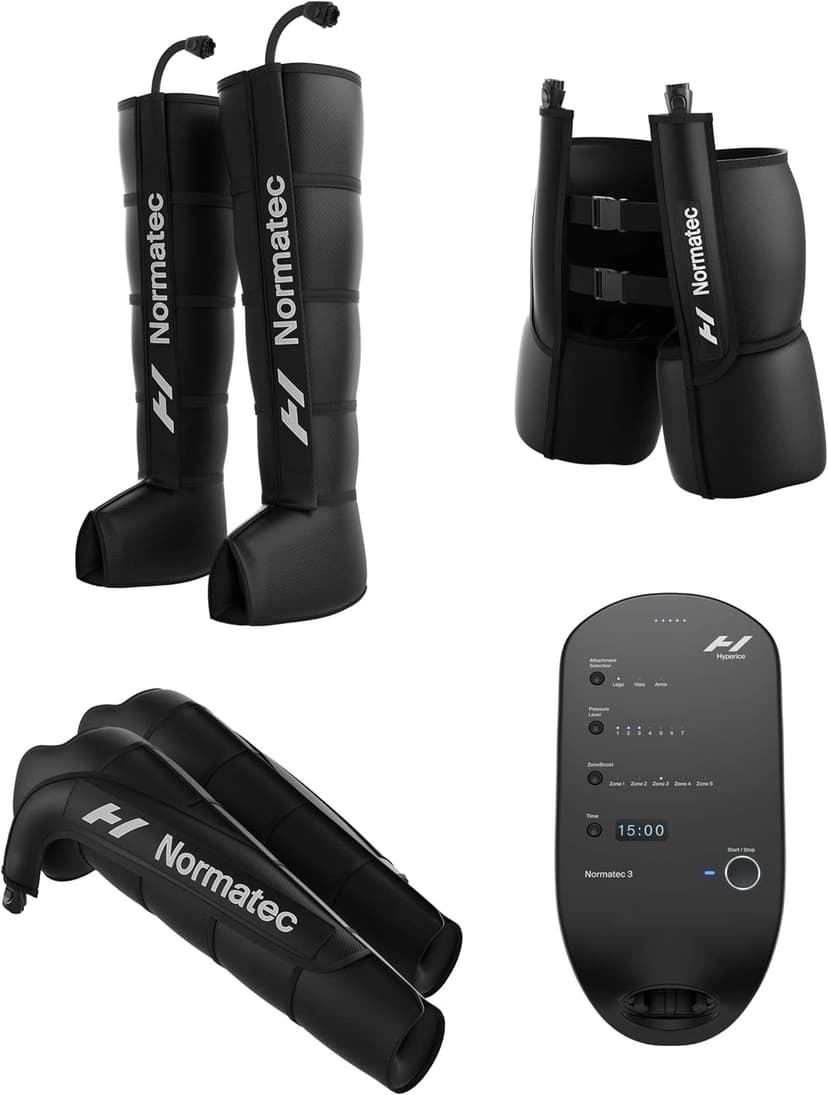
Normatec 3
Hyperice pneumatic compression boots with 5 zones, 7 pressure levels, ZoneBoost and app control.
Therabody RecoveryAir PRO: more room to adjust, more weight
The RecoveryAir PRO is the Normatec 3's direct rival. According to the spec sheet of the retailer Fleet Feet, pressure is adjustable from 20 to 100 mmHg with per-chamber control, there are four inflation cycles (sequential, wave, isolation and flow), four preset programs and a free mode, sessions of 10 to 90 minutes and up to 240 minutes of battery life. Therabody also presents two proprietary technologies: TruGrade, which it describes as negative-gradient pressure from the feet upward, and FastFlush, with a full inflate-and-deflate cycle of about 60 seconds.
These two labels should be read for what they are. What is described is a design, and whether it translates into a specific physiological effect is a manufacturer claim that cannot be treated as demonstrated. As for FastFlush, the brand presents it as two to three times faster than the competition, but the footnote on its own website clarifies that the comparison is made against Normatec's quick-deflate mode: it is a marketing comparison, not an independent measurement.
On paper, the Therabody offers more customization and more battery life; in exchange, its unit weighs 2.14 kg according to the retailer, more than the Normatec 3's. More control is not automatically better: anyone who won't adjust parameters will barely notice the difference.
User information on this model is practically nonexistent. The Slowtwitch thread that asks about the JetBoots contains no assessments of the RecoveryAir PRO, and no verifiable information on noise, durability or comfort was found, so none is taken as true.
There is also a notice here: the official RecoveryAir PRO pages we tried to open return a 404 error, and Therabody now presents the wireless JetBoots (Prime and PRO Plus) in its catalog. The official PRO Plus page describes four overlapping chambers, pressure from 20 to 100 mmHg in 5 mmHg increments, eight preset treatments, an LCD screen and, besides compression, vibration and LED infrared, with a battery life the brand puts at between 150 and 240 minutes. The brand does not state on the pages reviewed that they are successors to the RecoveryAir PRO, and vibration and infrared are features whose contribution to recovery was not assessed in the cited review, which is limited to compression. We could not confirm whether the RecoveryAir PRO has been discontinued, nor its availability on Amazon.es.
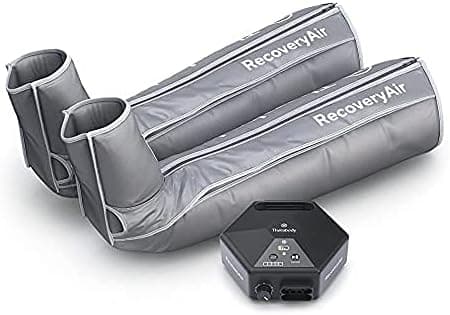
Therabody RecoveryAir PRO
Therabody pneumatic compression boots with TruGrade technology, a FastFlush cycle and app control.
Battery life, weight and portability
Both boots work with an external unit and a hose, and both manufacturers have shifted their focus toward cable-free designs (Normatec Premier and JetBoots). From the product-page figures, the Therabody advertises more hours per charge (up to 240 minutes versus the Normatec 3's 3 hours) and the Normatec 3 is the lighter one. Battery life is rarely the deciding factor at home: in the Normatec user thread, people talk about sessions of 30 minutes to an hour, and the RecoveryAir PRO lets you schedule between 10 and 90 minutes. It matters more if you travel with them or share the equipment.
In both cases you need a reasonably sized bag: the unit, hoses and long boots do not fit in a small gym bag. Anyone looking for something pocket-sized will not find it in this category, and in that case a tool such as a massage gun makes more sense.
Software and fees
Both brands use Bluetooth and their own app. On the Normatec 3, Hyperice says the app unlocks additional features and customization, and the product page mentions no fee. On the RecoveryAir PRO, according to the retailer, the app lets you save and share routines, and no fee appears in the product pages consulted either. A fee missing from a product page does not mean there is none: it is worth confirming on the manufacturer's website before buying, especially with the newer models, whose documentation was not reviewed in depth on this point.
A practical question is whether there are preset programs by sport or goal. The Therabody has four programs and a free mode; on the Normatec 3 the product page does not list named modes, and anyone who wants guided programs should check them in the app before buying.
Sizes and fit
Sizing is one of the most common sources of frustration with compression boots. Hyperice offers three sizes (short up to about 170 cm, standard from about 170 to 193 cm and tall from about 193 cm), although some retailers publish slightly different ranges. Therabody organizes sizes by leg length measured from ankle to hip: roughly 69 to 85 cm in the small, 80 to 95 cm in the medium and 90 to 104 cm in the large, according to the retailer. Forums mention occasional complaints about the zippers or the length of the boots on tall people. Measure before ordering and check each manufacturer's current size charts.
Models not reviewed here
This comparison only includes models that have a review and verifiable data. Forums mention boots from other brands with simpler features and a much lower price, but none has been reviewed and no figures are given for any of them. A simple boot can be reasonable for someone who only wants an occasional sense of relief, because the evidence studies the technology and not a brand. Before buying a model we have not reviewed, compare its official product page and read the manufacturer's contraindications.
One specific caution: a Renpho-brand product that used to be linked on this page turned out to be a calf massager and not full-leg boots, and its data have not been verified in an official source. That is why it does not appear in the table and is not recommended. Always check on the purchase page which part of the leg a product covers before taking it for a compression boot.
Contraindications and safety
Before performance, it matters who should not use them. Each manufacturer publishes its own, and those are the ones that count; what follows is a partial summary, not a substitute.
- Normatec 3. The user manual (a copy of the manufacturer's manual published on ManualsLib) lists, among others, acute infections, deep vein thrombosis, episodes of pulmonary embolism, wounds, injuries or tumors in or near the area of application, fractures or dislocations in that area and situations in which increased venous and lymphatic return is not desirable. In the portion consulted, pregnancy is not explicitly mentioned, which does not mean there are no precautions.
- Therabody. The Therabody precautions and contraindications page has a section for the RecoveryAir systems. Contraindications include known or suspected deep vein thrombosis, pulmonary embolism, active phlebitis, pacemakers and implantable defibrillators, significant arterial insufficiency, decompensated heart failure, uncontrolled hypertension, clotting disorders or anticoagulant medication, and open wounds or bruises in the area. The list is partial: the full page includes more cases. Among the precautions it mentions pregnancy, diabetes, varicose veins and osteoporosis.
- Other brands. Consult the manufacturer's own documentation, which was not reviewed here.
With pregnancy, circulatory problems, significant varicose veins, heart failure or any vascular disease, the sensible course is to consult a doctor before using any boot and to read the full manual. The boots are not a treatment: the documentation consulted does not indicate a classification as a medical device for these models, and they should not be understood as equipment for managing lymphedema or venous insufficiency or for preventing thrombosis.
Other ways to recover: percussion
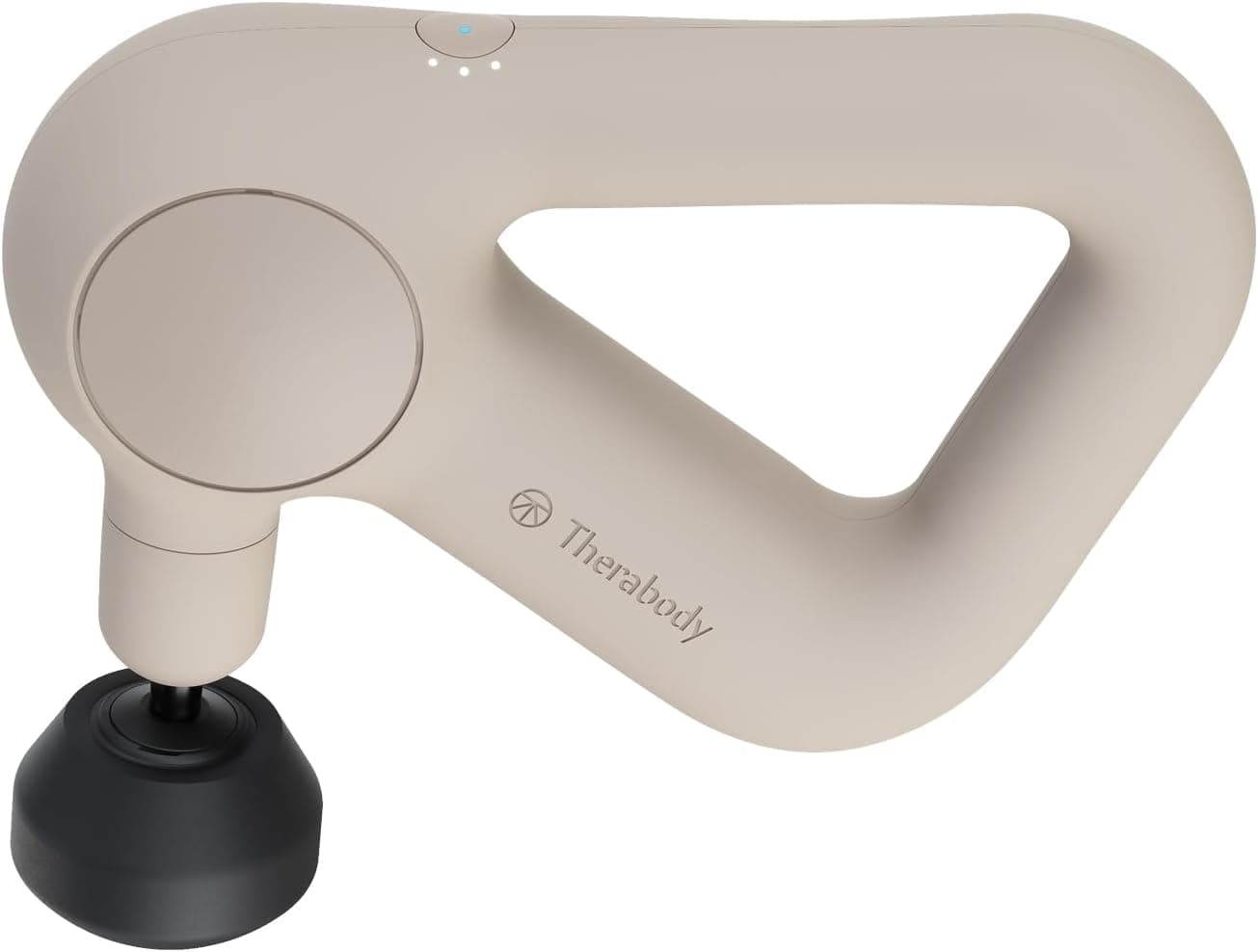
If the discomfort is localized rather than in the whole leg, a massage gun meets a different need, more targeted and portable. The Theragun Relief, Therabody's entry-level model, is the reference the site reviews. The systematic review by Ferreira and colleagues (2023) on massage guns in general found that they could improve flexibility and range of motion in the short term, with no improvements in strength or power, and with unknown long-term effects. It does not study that specific model, and it does not support faster recovery. They are not substitutes for the boots but different ways of approaching discomfort, and both have limited evidence.
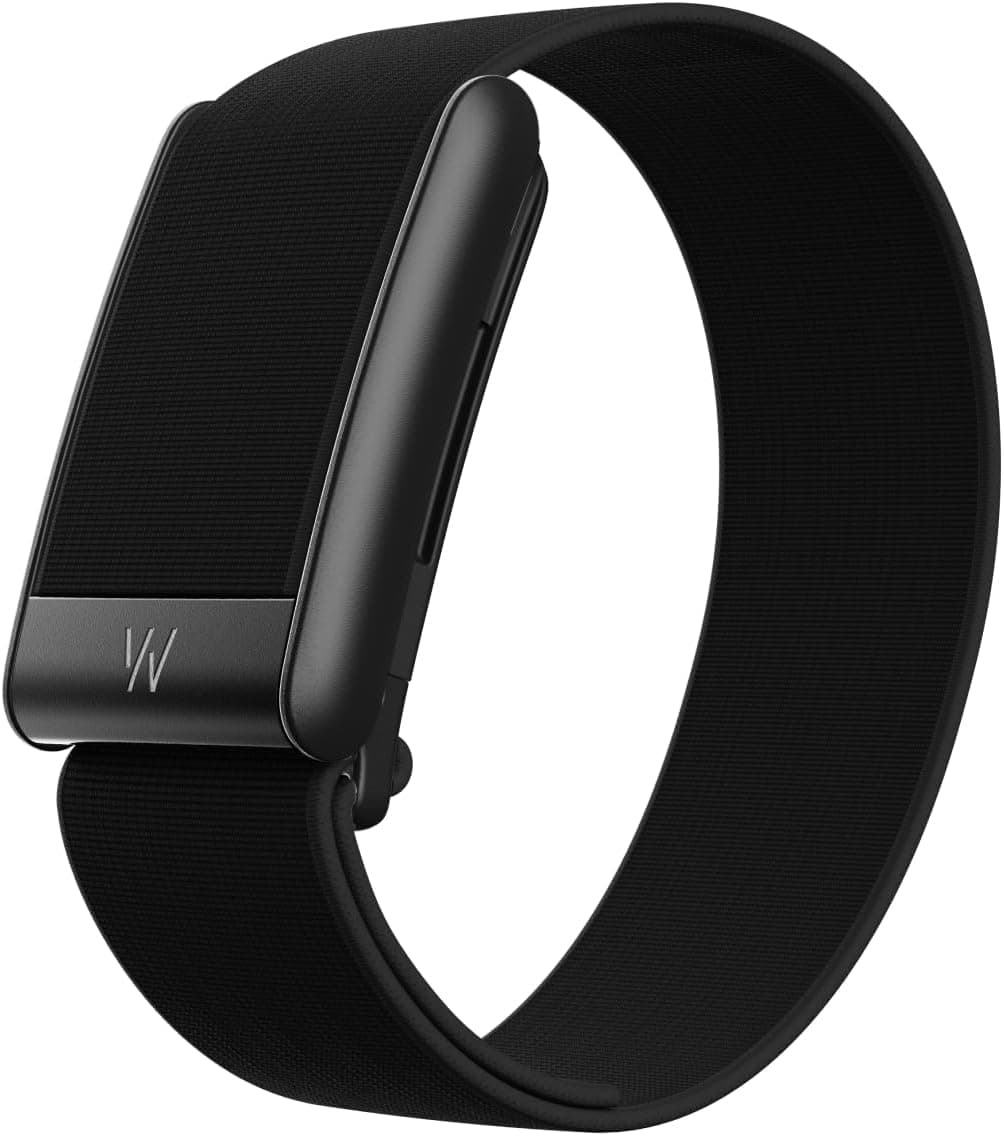
To decide with data whether the problem is recovery rather than training load or sleep, a wearable such as the Whoop 5.0 can help you see trends in strain and rest, although its recovery score is a proprietary index and not a validated measure of how recovered the body is. The muscle recovery guide gathers other levers, almost all cheaper: elevating your legs, easy walking and getting enough sleep cover part of the goal at no cost.
Which boot to choose by profile and budget
- You train at high volume and want the simplest, lightest system: Normatec 3. It is the default option for the cyclist, distance runner or strength athlete who will use the boots several times a week. Before buying, check whether the Normatec Premier is on sale in your market and compare.
- You want to adjust pressure per chamber and have more battery life: RecoveryAir PRO. It is the choice for someone who will make use of a free mode and saved routines. Check availability first and compare with the JetBoots, because we have not confirmed whether this model is still in the catalog.
- Tight budget: do not buy boots yet. If the problem is localized stiffness, look at the Theragun Relief (next profile). If you insist on pressotherapy, compare the manufacturer's product pages and contraindications before buying any model we have not reviewed.
- Everyday stiffness or one specific area, on a small budget: Theragun Relief before boots. It costs much less and takes up little room. Mind what it covers: the evidence on massage guns (Ferreira, 2023) refers to flexibility and range of motion in the short term, not to faster recovery. It suits localized stiffness, not leg fatigue.
- You train two or three times a week with moderate loads: do not buy either. Sleep, nutrition and load planning matter more than any device, and the evidence does not support that boots improve performance.
- You have thrombosis, circulatory or heart problems or another contraindication from the manufacturer: do not use them without consulting your doctor first.
Veredicto Final del Experto
Normatec 3
Lighter unit and no fee on the product page. Check first whether the Normatec Premier is on sale in your market.
Therabody RecoveryAir PRO
Per-chamber control and up to 240 minutes according to the retailer. Verify availability and compare with the JetBoots.
Avoid if…
You train little, expect better performance, or have a contraindication from the manufacturer. Consult a doctor first.