In this article
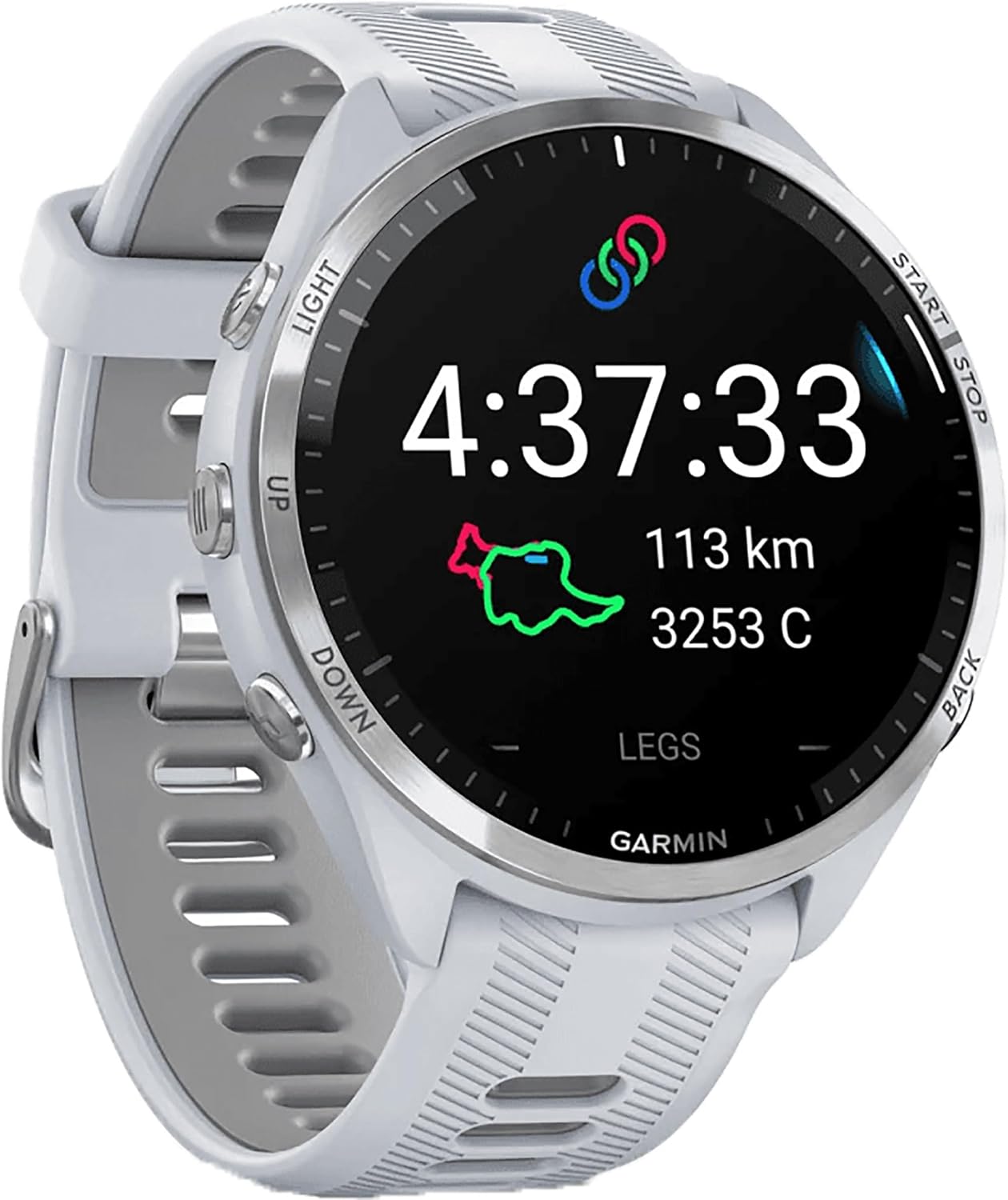
The Garmin Forerunner 965 is a running and triathlon watch with a 1.4-inch AMOLED display, multi-band GPS and built-in maps, which also tracks sleep and heart rate variability (HRV) to estimate whether you are ready to train hard or should ease off. Its case is twofold: it brings together in a single device what a serious runner uses during effort and what they want to see on waking, and it does so with a battery counted in days, not hours.
This review is based on Garmin's specifications and manuals, on specialist reviews (above all DC Rainmaker's in-depth test), on a review of the literature on HRV-guided training and on what users say on Garmin's official forum. It does not start from hands-on testing of the watch. And it should be read with one warning: it is not a medical device, and its recovery scores are training estimates, not a diagnosis.
Notice for buyers: the 965 came out in March 2023 and is no longer the newest Forerunner. Garmin introduced the Forerunner 970, alongside the 570, in 2025, and its own blog describes it as an evolution of the 965 with a brighter display and sapphire crystal, more GPS battery life and new training features. Garmin's blog does not say the 965 has been discontinued, and its listing is still active on Amazon.es. Further down, in the "965 or 970" section, we explain who the earlier model still suits.
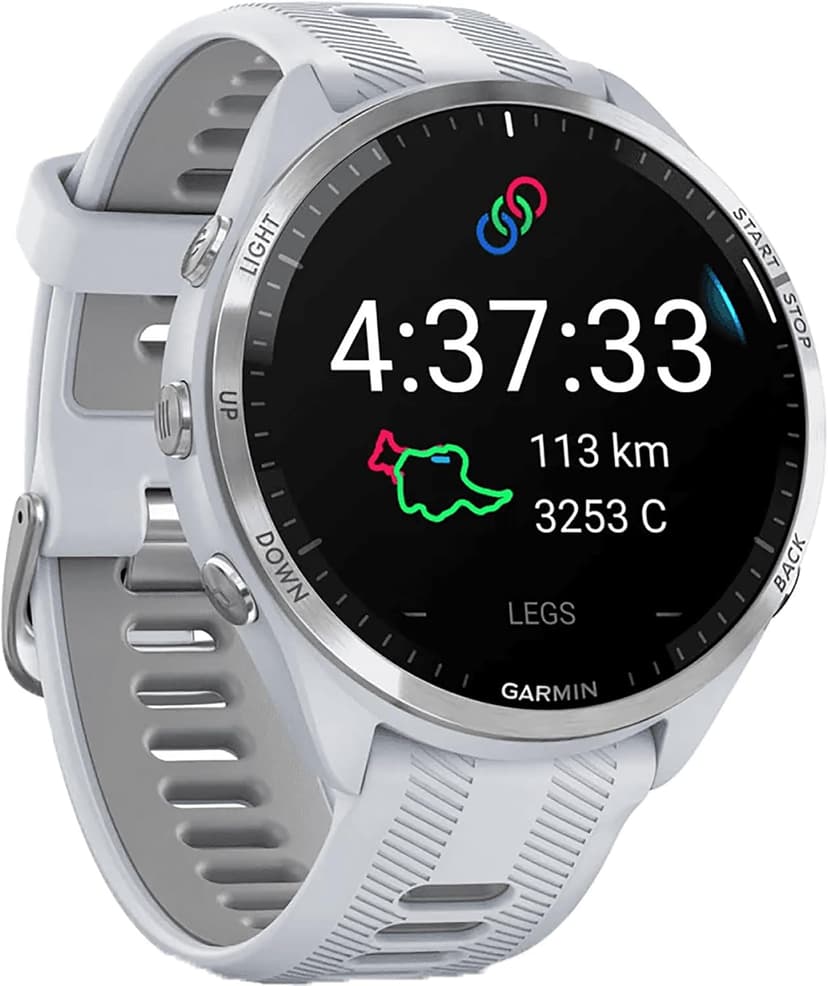
Garmin Forerunner 965
Running and triathlon watch with AMOLED, multi-band GPS, maps and HRV and readiness metrics, with up to 23 days of battery in watch mode.
Pros
- •Battery of up to 23 days in watch mode and up to 31 hours of GPS, according to Garmin's manual, although the figure drops with multi-band GPS and the always-on display.
- •Multi-band GPS with SatIQ, which switches modes to save battery; in DC Rainmaker’s test the running and cycling tracks came out clean.
- •Overnight HRV and a daily training readiness score with no mandatory fee: existing Garmin Connect features remain free, according to Garmin.
- •Light (53 g) with a titanium bezel, built-in colour maps and up to 32 GB for music.
Cons
- •It is the previous model: the Forerunner 970 adds a brighter sapphire display, flashlight, speaker and microphone, and ECG.
- •No ECG sensor, and in specialist tests the optical HR failed in very short intervals.
- •With the always-on display, battery life falls well below the advertised 23 days, and Garmin also offers an optional subscription (Connect+) that covers new features.
What it measures and how it turns that into recommendations
The Forerunner 965 measures heart rate at the wrist, tracks sleep and measures HRV overnight. With that data, the watch builds several layers of information that are worth telling apart, because they do not have the same backing.
Overnight HRV (HRV Status). According to the launch press release, HRV is recorded during sleep and shown in the morning report. In his test, DC Rainmaker explains that the watch needs about 19 nights of data to set a baseline, that this baseline can extend to a rolling 90-day window and that a single bad night does not change the status, whereas a week of illness does. In other words: the value lies in the trend against your own baseline, not in a single number. The same author compared average overnight HRV on the Forerunner 955 with a Polar H10 heart rate monitor and got 54 ms versus 52 ms; he states that the 965 uses the same sensor and the same algorithms, but that comparison is not a measurement of the 965 itself.
Training Readiness. Garmin describes it as a daily score based on sleep quality, recovery time, training load and other factors. DC Rainmaker adds that it also combines HRV status, acute load and sleep and stress history, and that he uses it each morning as an indicative check, without relying on it alone. He also points out a practical caveat: on the 965 it cannot be shown as a field on the watch face.
Morning report. It summarises the night's sleep and the day's training outlook, with the HRV status. It is the screen where the other metrics end up converging.
One limit to keep in mind: the readiness score is a proprietary algorithm. Garmin says which variables go in, but not how much each one weighs, and we have not found an independent validation of Training Readiness on the 965. Sleep staging is also an estimate: DC Rainmaker observed that sleep stages and scores varied widely between the 965 and the Forerunner 265, which he wore at the same time. The same applies to this data as to any other consumer wearable: it is useful for seeing trends over weeks, not for interpreting a single night or for diagnosing sleep or health problems. If you have health concerns, the right step is to consult a healthcare professional.
Does training by HRV improve performance?
This is the underlying question of "sports biohacking", and the evidence is more modest than the marketing suggests. A systematic review with meta-analysis of 8 studies and 199 participants (search through October 2020) found a benefit in vagal-tone HRV indices after adjusting for methodological factors, but small, statistically non-significant effects on maximal aerobic capacity and endurance performance (both with a standardised mean difference of 0.20). Another review of randomised trials focused on VO2max, with six trials and 195 participants (search through June 2020), describes a small but positive effect of HRV-guided training, larger in recreational athletes than in elite ones. Its own authors acknowledge very high heterogeneity (I² = 94%) and an unclear or high risk of bias in the included studies, so its results should be read with caution. Neither includes work published after 2020.
A cautious reading: being guided by HRV may help you avoid piling on intensity when your body is fatigued, but there is no solid evidence that a watch, on its own, improves your times. The metric informs decisions; you make the decisions. If your main interest is sleep or recovery without training with GPS, a ring such as the Oura Ring 4 or a band such as the Whoop 5.0 focus more on that.
GPS and heart rate: what the tests say
The 965 supports several satellite modes, including multi-band, and SatIQ, which according to DC Rainmaker appears in the menus as "AutoSelect" and switches between multi-band and standard mode as needed (the Spanish-language manual calls that mode "Seleccionar automáticamente"). In his tests (a tempo run between jungle and a residential area and a road bike ride along a coastal road) he describes the tracks as perfect, never straying off the right side of the road. He also tried an open-water swim, but the test was cut short at about 90 metres because of a shark and does not give a reliable assessment. He gives no error figures, so the result is qualitative and from a single reviewer.
On optical heart rate, the same analyst compared it with chest straps and concludes that it was almost identical in steady running, tempo and VO2 intervals on a bike trainer, and reasonably good on the road bike. The main failure was short intervals on asphalt, of 400 and 200 metres, where the 965 showed lag and in some of the 200s "had problems"; in that review, the Forerunner 265 did better in those repeats. He suggests the sensor may have been locking onto cadence. The practical conclusion: the wrist is fine for almost everything, but if you do very short repeats and every beat matters, a chest strap remains more reliable.
Battery: what Garmin says and what the tests show
The official Forerunner 965 manual gives a broad table (the figures in this list, including the 22- and 34-hour ones, come from that table), and the 23-day figure describes only watch mode:
- Watch mode: up to 23 days.
- Activity with GPS only: up to 31 hours.
- Activity with GPS on automatic selection: up to 22 hours.
- Activity with all systems plus multi-band: up to 19 hours.
- With music, between 10.5 and 8.5 hours depending on the GPS mode.
- UltraTrac: up to 34 hours.
The key lies in what is not included in those figures. DC Rainmaker points out that Garmin does not publish a figure for the always-on display. His first unit ran out of battery in under three days with that feature, and Garmin replaced it; with the replacement unit, after about seven and a half hours of workouts, it reached 5% six days after being charged to 100%. He measured consumption of between 1.33% per hour on the trainer and 3.6% per hour with GPS and a power meter, and a charge of roughly one hour from 10% to 90%. Another user quoted in that review mentions 6.5 to 7 days with the always-on display and about six hours of outdoor GPS.
On Garmin's official forum there is a thread on the 965's battery drain in which users, with the always-on display turned off, report mixed results: the thread's author mentions less than 10 days with music, notifications and several workouts a week, while another calculates 4-5% a day without music, consistent with the 23 days. A respondent points out that Garmin's figure does not include the always-on display. In that thread, music played from the watch is the clearest drain: around 10-12% per hour of running with headphones, compared with 4-5% without music.
Summary for deciding: if you turn the always-on display off, weekly battery life is realistic; if you keep it on, expect to charge every few days. Either way, it is far more than the Apple Watch Ultra 3, whose review, based on OutdoorGearLab tests, talks of about two days of mixed use.
Software and subscription: what is free and what is not
Garmin's advantage over Whoop or Oura is that the watch works without a fee: according to Garmin, "all existing features and data in Garmin Connect will remain free". The caveat is that in 2025 the company launched Garmin Connect+, an optional subscription that adds new features, among them AI-generated insights (Active Intelligence, in beta at launch), a performance dashboard with comparative charts, live activity on the phone during indoor workouts, expanded LiveTrack and extra content for Garmin Coach training plans. It has a 30-day free trial and a monthly or annual plan.
Who it matters to: if you use it to view your workouts, sleep, HRV and readiness, you do not need it. The risk, from what is read on user forums, is that some of Garmin's new features may end up arriving only on the paid plan. That is a concern among users, not a fact confirmed by Garmin for this model. It is worth checking the Garmin Connect+ page before buying, because the list changes over time.
There are also less obvious costs: music from services such as Spotify or Amazon Music requires each service's own subscription, and straps, the chest strap and external sensors are bought separately.
Design, comfort and maps
The watch measures 47 mm for the case, 13.2 mm thick and 53 g with the titanium bezel, according to DC Rainmaker, who compares it with the Forerunner 955 Solar (52 g, with the same 47 mm case). The AMOLED display is 454 x 454 pixels, and in the launch press release (Garmin Singapore version) the company presents it as its largest AMOLED display, at 1.4 inches, and the 965 as one of its first GPS running watches with AMOLED. It includes colour street and trail maps, as well as up to 32 GB of media storage. According to Garmin’s owner’s manual, water resistance is 5 ATM (pressure equivalent to a depth of 50 metres), rated for swimming.
For sleeping in it, bear in mind that it is a 47 mm watch, bulkier than a ring. If night-time comfort matters to you, that trade-off is real, and it is the reason many buyers end up considering a ring or a band as a complement.
Limitations: what it does not do
DC Rainmaker lists as shortcomings of his test unit the absence of ECG and of solar charging, the lack of Outdoor+ satellite maps, and the inability to use Training Readiness as a watch face data field. He also notes that iOS users cannot reply to notifications. These are observations from the 2023 launch: Garmin may have fixed some of them with updates, and we have not been able to verify that.
965 or 970: is the earlier model worth it?
According to Garmin's blog, the 970 brings a brighter AMOLED display, sapphire crystal, Triathlon Coach and pool duathlon and triathlon activities, running tolerance, LED flashlight, speaker and microphone, skin temperature tracking, an evening report and an ECG app. In GPS with all systems plus multi-band it states up to 21 hours versus 19, and with music 12 versus 8.5. In the 970's manual, watch mode comes to up to 15 days, versus the 965's 23.
That leaves an honest reading:
- Choose the 970 if you want ECG, the brightest display, sapphire crystal, calls from your wrist or triathlon training, and accept less battery life in watch mode.
- The 965 still makes sense if what you want is battery life in daily use, maps and recovery metrics, and you do not need those new features, especially if you find it on sale.
- There is no reason to switch from the 965 to the 970 just for recovery metrics, because the new features Garmin's blog lists for the 970 are different ones.
A caution: price and availability change daily, and we do not give them here. The useful thing is to look at both models on the same day on Amazon.es and check how far apart they are.
Alternatives
- Fee-free and light: Coros Pace 4. According to its review, it is a light AMOLED watch with HRV, sleep tracking and weeks of battery, and with a sports-focused ecosystem, with no fee mentioned for those features. It has no ECG or skin temperature.
- Full smartwatch: Apple Watch Ultra 3. More phone and payment features, less battery and, according to its review, no daily recovery score in Apple's documentation.
- Recovery without a screen: Whoop 5.0. A band with a mandatory membership, focused on recovery and strain more than on training with GPS.
- Sleep with nothing on your wrist: Oura Ring 4. Designed for the night, not for effort, and with a fee for the full app.
Verdict
The Forerunner 965 remains a very solid watch for runners and triathletes: multi-band GPS that, according to the tests, performs well, optical heart rate that is reliable except in very short repeats, maps, and an ecosystem that does not force you to pay a fee. It loses strength for three reasons: it is a 2023 model with a successor, the 23-day battery life is only achieved in favourable conditions and the recovery side has no published independent validation for this watch.
Our score weighs, in this order, the accuracy of what it measures, software and subscription, battery life, comfort and value for money. The 84 out of 100 reflects GPS and HR accuracy that is good in reviews but without error figures or HRV validation on this model, powerful software that does not require a fee although there is now an optional subscription, very good battery life with caveats, comfort that is adequate but bulky for sleeping, and a value that depends on what you find against the 970.
Veredicto Final del Experto
Garmin Forerunner 965
Runner or triathlete who wants multi-band GPS, maps and recovery metrics with no mandatory fee, and weeks of battery.
Garmin Forerunner 970
Someone who wants ECG, the brightest display, calls from the wrist or triathlon training, and accepts less battery life in watch mode.
Skip it if…
You want the slimmest watch to sleep in, voice calls or the latest Garmin generation.


