
In this article
A wake-up light replaces the abrupt sound of an alarm with a light that rises gradually in the minutes before your wake-up time. The Philips Wake-up Light HF3519/01 is one of the most feature-rich models in Philips' SmartSleep range: colour sunrise, two alarms, five natural sounds, FM radio, a sunset function and a reading lamp. This piece brings together what Philips publishes, what has been studied about simulated dawn in general and what users say, and compares it with the Lumie Bodyclock Shine 300, the other option we review in this category.
This site has not tested the device: the review relies on Philips' official documentation, published studies and user opinions, summarised as such. What we could not check is declared in the final section.
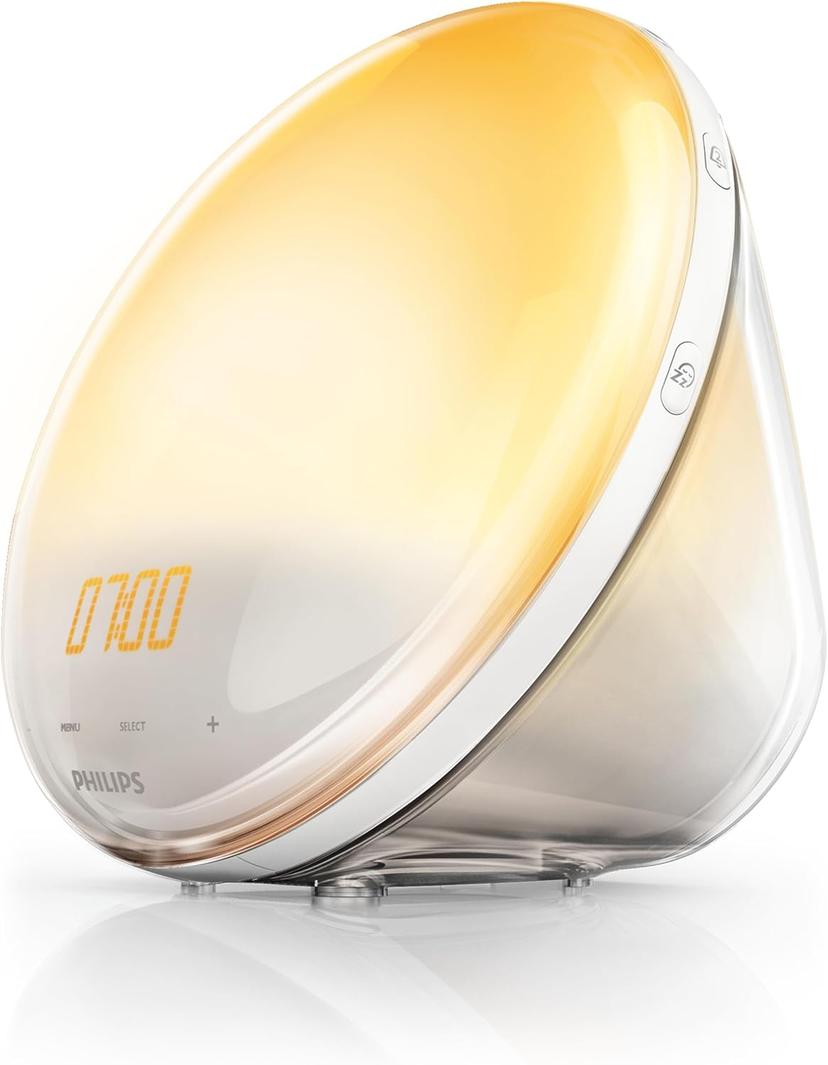
Philips Wake-up Light HF3519/01
Wake-up light with a 20 to 40 minute colour sunrise, 300 lux, FM radio, five natural sounds, two alarms and sunset.
Exactly which product this is
HF3519 is the model and /01 is the variant code shown in Philips' listing and documentation. The Amazon.es listing linked in this piece is titled "PHILIPS HF3519/01 Despertador de luz con simulación del amanecer, Radio FM y lámpara de lectura, 5 sonidos naturales, Alarma diferida, Blanco" and, as of November 16, 2026, had a buy button and an average rating of 4.4 out of 5 from 993 ratings, according to the listing itself.
A useful warning for anyone comparing: Philips has a more basic model, the HF3500, with no radio, a single beep and no sunset, and it now lists it as discontinued. It should not be confused with this one: the HF3519 is a model on sale, with a specification sheet published on its website (October 2023 edition).
On the light figure, which some listings mix up: the HF3519/01 sheet says 300 lux; the 200 lux of other models, such as the HF3500, is not this one's figure.
What Philips publishes
The data in this section comes from the HF3519/01 specification sheet (issued October 2023), the HF3519 user manual, which includes a Spanish section, and the important information manual for the HF3519, HF3521, HF3531 and HF3532 models. These are manufacturer data, not independent measurements. The specification sheet we read is the one from the UK version of the listing.
- Colour sunrise: the light goes from a soft red to orange and bright yellow. It lasts 30 minutes by default and the manual lets you shorten it to 20 or 25 minutes or lengthen it to 35 or 40.
- Intensity: 20 brightness levels and a light intensity of 300 lux, according to the specification sheet. According to the important information manual, the light runs from approximately 1 to 300 lux measured at 45 cm, and its colour from approximately 1500 to 2800 K. The user manual recommends placing the device 40-50 cm from your head, for example on the bedside table.
- Alarms: two, each with its own profile (time, sunrise duration and sound), meant for, say, weekdays and weekends.
- Sounds: five natural sounds (according to the sheet: forest birds, Buddha, yoga, ocean waves and Nepalese bowls) and FM radio. Philips says the sound rises gradually to the chosen volume over a minute and a half.
- FM radio: yes, with automatic station search by holding the button down. It can also be used as the wake-up sound.
- Snooze: a tap on the top postpones the sound by 9 minutes; the lamp stays on. According to the manual, the tap works once the sunrise has finished and the alarm is sounding.
- Sunset ("fall asleep"): the light dims gradually with a timer of 5 to 60 minutes and, if the radio was already on before the sunset was activated, the volume goes down with the light. If you don't set the time, it dims over 30 minutes.
- Lamp: it can be used as a bedside or reading light, with adjustable intensity. Philips specifies that it is not a general lighting product.
- Display: adjustable from level 0 (off) to 4, and its brightness rises on its own if there is a lot of light in the room, according to the manual. The buttons have tactile backlighting.
- Power: mains adapter; the important information manual gives 24 V DC, 0.5 A and 12 W (the sheet: 100-240 V input and 12 W output). The sheet also gives 16.5 W for the device's power, against the manual's 12 W.
- Time after a power cut: 4 to 8 hours according to the documentation (the manual says "up to 8"; the sheet, "4 to 8"). It has no battery, so it is to be expected that there is no light or alarm; the manual only confirms that the time is stored.
- LEDs: not replaceable. The adapter is.
- Dimensions and weight: 19.2 x 19.9 x 14.6 cm and 730 grams, according to the sheet.
- Connectivity: the sheet states that it is not controlled by an app and that it does not play music from your phone or charge it.
- No app or sensors: setup is done with buttons and a menu on the device itself, and it does not measure sleep.
- Warranty: the Philips documentation we read refers to its international warranty leaflet and does not give a figure. The Philips UK listing shows a "2 year warranty" banner without detailing the conditions; we do not give it as fact.
A discrepancy worth knowing about: the Amazon.es listing mentions light "gradually brighter in 5 levels", while Philips' sheet and manual give 20 brightness levels. If a sales listing contradicts Philips' own, go by Philips'.
A practical detail from the manual: holding down the alarm 1 or 2 button for three seconds makes the device run through the increase in light and sound in 90 seconds. It lets you see how it behaves with your chosen settings before relying on it for a night.
What has been studied about simulated dawn
As far as we could check, none of the studies below used the HF3519 or any other specific device in this range. They describe the "light that rises before waking" category, with different devices, light levels and populations. Philips states in its specification sheet that the research on its Wake-up Light was done "in independent scientific centres", but does not say which ones, so we cannot verify them.
Sleep inertia: the grogginess of the first minutes
Sleep inertia is the drowsiness and grogginess of the first minutes after waking. There are three studies with people who report difficulty waking up, two of them with 16 and 8 participants:
- In a 2010 study with 16 healthy adults, with a control night and another with 30 minutes of artificial dawn, in random order, self-reported sleepiness was lower and activation higher with the dawn. There were no significant effects on task performance, core temperature or cortisol.
- A 2010 home study compared 0, 50 and 250 lux, and then 0 lux against an intensity chosen by the person, with two weeks per condition. Complaints of sleep inertia fell significantly with the dawn, without a significant shift in melatonin. The abstract does not give the number of participants.
- A 2014 study with eight people found, with the dawn, higher perceived sleep quality, more self-reported alertness, more sums completed and a faster reaction time (0.81 s versus 0.86 s), all significant according to the abstract and with eight people; a cycling test was 4.7% faster, without statistical significance.
The pattern is consistent in the subjective and mixed in the objective. With samples of eight and sixteen people, it cannot be generalised to anyone. And in a 2024 laboratory study with a system combining light, sound and temperature, the overall effect was small compared with a traditional alarm clock. Another 2020 study with 23 middle-aged and older adults found no effect on alertness or on balance when getting up; it did observe that the dawn reduced the time spent asleep before the wake-up time by 33%. In that group, then, the light brought waking forward, and that is not necessarily an advantage.
Performance and mood on little sleep
A 2013 laboratory study with 17 participants put people through two nights of six hours of sleep and compared, in the morning, a simulated dawn of up to 250 lux with dim light and with blue light. With the dawn, self-reported mood and wellbeing were better, and cognitive performance improved after the first night, but not after the second. This is a laboratory setting with mild sleep deprivation, not an ordinary morning at home.
A community trial on sleep quality
A 2003 community trial gave dawn simulators to 100 volunteers, 77 of whom completed the study, with two-week periods of use alternating with periods without it. The sleep quality they reported each morning improved while they used it (from the sixth day on) and the effect did not persist once they stopped; the authors themselves describe it as modest. Each person acted as their own control and the measure is subjective: it does not show a change in objectively measured sleep.
Seasonal affective disorder, with caution
Here we need to be stricter, because this is a clinical diagnosis, not a bad wake-up.
- A 2001 trial with 95 adults with seasonal affective disorder (SAD) compared, over six weeks, a 90-minute dawn reaching 250 lux, 30 minutes of 10,000 lux bright light and a very dim 0.5 lux red light as placebo. The dawn produced more remission and response than the placebo and than the bright light.
- A 2006 trial with 99 adults with seasonal-pattern depression, with a dawn reaching 250 lux, did not find the dawn to be superior to bright light or to a light pulse: improvements were 49.5% with the dawn and 57.1% with bright light. The authors nonetheless consider it a candidate alternative to bright light.
- A 2015 crossover study with 40 people found a similar improvement with dawn and with bright light after one week, and those with greater severity tended to notice more improvement with bright light.
- A 2005 review with meta-analysis associated simulated dawn with lower symptom severity in SAD (five studies, effect size of 0.73), with the caveat that it warns that many studies did not have a rigorous design.
What this lets us say is limited: in people with SAD there are trials with favourable results and others with no advantage over bright light. It does not allow us to claim that the HF3519 treats SAD or that it helps someone who feels low in winter. Philips, in fact, states in its precautions that anyone who has had or has depression should consult their doctor before using the device.
300 lux is not light therapy
The cited studies whose abstract states the intensity used peaks of up to 250 lux, with a light that rises while you sleep. Classic light therapy with bright light lamps works at 10,000 lux, as in the 2001 trial, and is used awake, in front of the lamp. The HF3519 states 300 lux as a maximum: the same order as the simulated dawn studies, and around thirty times less than a light therapy lamp. Philips measures the 300 lux at 45 cm, the distance it recommends for the head; the light reaching the closed eyes of a sleeper will be lower. We do not know at what distance the studies measured their light, so the figure is of the same order, not equivalent.
The sunset
Philips presents the sunset as a function that "prepares the body for sleep" by reducing the light gradually. This is a manufacturer claim and we have not found studies on artificial sunsets with this device or others, so we do not present it as supported. What can be said with the manual in hand is the practical side: the lamp lowers the light over the chosen time and can be accompanied by the radio, whose volume goes down with the light if it is switched on before the sunset is activated.
What Philips claims and how to read it
The commercial sheet maintains that the Wake-up Light is "the only clinically proven" one and that it not only wakes you more naturally, but also "more energised" and improves mood in the morning. These are manufacturer claims. It does not identify the studies in the documentation we read, and the independent evidence we found is what is above: favourable in the subjective, with small samples and uneven objective results.
Philips adds that "92% of users" find it easier to get up, and attributes this to independent research from 2011 with 209 people (Metrixlab). Philips does not describe the methodology; from the figure and the name (Metrixlab, a market research firm) it looks like an opinion poll, not a clinical trial: it would measure what people say they notice, not a physiological outcome. That is why this piece does not say that the HF3519 "improves sleep" or "mood". It says that a subjective effect has been observed in studies on the category.
The manual adds precautions: it is not a general lighting product; it should not be used to sleep fewer hours ("it does not decrease your need for sleep"); if you wake too early or with a headache, you should lower the intensity or shorten the sunrise; and if you share a bedroom, the other person may wake with the light even if they are further away. Philips states that the device meets the European photobiological safety standard for lamps (IEC 62471). The documentation consulted does not present it as a medical product: it is a consumer device.
What users say
What follows summarises the reviews on the HF3519/01 listing on Amazon.es as of November 2026 (4.4 out of 5 from 993 ratings). The listing itself states that its summaries are AI-generated from the reviews, and they are buyer testimonials from a sample we cannot measure, so we treat them as trends and not as figures.
- In favour: quality, with 33 of the 35 positive mentions according to that summary. People repeatedly say it wakes you gently, that the light "lights up the whole room", that the sounds are delicate and that the sunrise and sunset are relaxing. One review says the light helps with waking up "in addition to the sound", and its author still sets another alarm five minutes later as a backup.
- The most repeated complaint: the controls. Eight reviewers talk about them and seven do so negatively: they don't find them intuitive, setting the alarm requires knowing the menu and the buttons on top are hard to tell apart by touch.
- Size and sounds: some reviews say it is bigger than expected and that its round shape is unstable on the bedside table; the sounds get mostly positive comments, with the odd complaint that there are few.
- Power cut: the summary mentions the 8 hours without electricity, a figure that matches the manual (the sheet gives 4 to 8); it does not detail what happens to the light and alarm.
- Price: opinions are divided; some users consider it expensive for what it offers.
Versus the Lumie Bodyclock Shine 300
The direct comparison is with the Lumie review. The Lumie data is what its manual publishes and is detailed in its piece; the Philips data is what is above.
| Aspect | Philips HF3519/01 | Lumie Bodyclock Shine 300 | | :- | :- | :- | | Sunrise duration | 20 to 40 minutes | 15 to 90 minutes | | Light levels | 20, up to 300 lux (Philips) | 20; no lux figure published | | Alarms | 2, each with its own profile | Daily or weekly, with a different time per day | | Sounds | 5 natural sounds | 15 wake-up and sleep sounds | | Radio | FM | FM with five presets | | Sunset | Yes, 5 to 60 minutes | Yes, 15 to 90 minutes | | Time without power | 4 to 8 hours (sheet) / up to 8 (manual) | 30 minutes (Lumie manual) | | Warranty | Not verified | Three years (Lumie manual) | | Light colour | Red to yellow (Philips) | Warm white, orange and red (Lumie, 2018) |
What the Lumie gives you extra: a much more flexible sunrise (up to 90 minutes, the longest duration in the cited trials), more sounds and a documented three-year warranty. What the Philips gives you extra: a published lux figure, which allows comparison with the studies, a time backup of 4 to 8 hours versus half an hour and two alarms with their own profiles. In both cases the evidence for the category is the same and neither has studies of its own that we have found.
What it costs to maintain
- Software: none. There is no app or sleep data. If you want to measure whether anything changes, you need another device, such as a ring with no subscription, bearing in mind that these are consumer products and not medical ones.
- Consumables: none.
- Maintenance and use: soft cloth with the device unplugged, no abrasives or solvents; indoors only, away from damp and between 5 and 35 degrees, according to the important information manual.
Practical use and limits
These notes are deductions from the documentation, not test results.
- With a sleep mask: the light has to reach your eyes. A sleep mask like the MyHalos blocks exactly that, so the two goals clash; we have not seen studies on combining them.
- With little natural light: in winter, with late sunrises, the lamp brings the light forward. Studies in people without SAD mainly measure sleepiness on waking and, in one case, mood on little sleep; none follows mood through the winter.
- Menu: given what users say, it is worth setting it up with the manual in front of you before the first night.
Alternatives and complements
- At night, blue-light blocking glasses try to reduce short-wavelength light in the hours before bed; the evidence on them is limited and is discussed in their piece.
- A wake-up light with more margin in duration and sounds: the Lumie in the comparison. Within Philips there are other models we have not reviewed, such as the more basic HF3500, now discontinued.
- Without a device: opening the blind on waking, or leaving it open, aims at something similar in seasons with natural light at that hour. We have not seen studies comparing that option with the device.
How we score this piece
Our score weighs, in this order, the accuracy of what the product promises or measures, software and subscription, battery life, comfort and value for money. A wake-up light measures nothing, so the score depends on how much supports what it promises and how much verifiable information the manufacturer gives. Result: 64 out of 100.
- In favour: Philips publishes concrete figures (300 lux, 20 levels, a 20 to 40 minute sunrise, time backup of 4 to 8 hours) and detailed manuals with precautions. It has two alarms with their own profiles, FM radio and sunset, and no subscription, app or consumables.
- Against: there are no studies with this model and the evidence for the category comes from small samples, with uneven objective results; the sunset and "clinically proven" claims are manufacturer claims; the sunrise does not go beyond 40 minutes; only five sounds; unintuitive controls according to users; non-replaceable LEDs; and we cannot verify the warranty, comfort or durability.
It ends up at 64 because what weighs most, what light it emits and what supports what it promises, is better documented than on other wake-up lights and the device offers a complete set of functions, but the evidence is for the category and not the model. It sits somewhat below the Lumie despite publishing the lux because, on comfort and durability, the Philips has less room for adjustment (a sunrise of up to 40 minutes, five sounds), controls criticised by users, non-replaceable LEDs and no documented warranty, whereas the Lumie documents three years.
Pros
- •Philips publishes 300 lux, 20 light levels and a 20 to 40 minute sunrise, figures that allow comparison with the studies on simulated dawn.
- •A complete package: two alarms with their own profile, FM radio, five sounds, sunset and the time kept for 4 to 8 hours without power, according to the documentation.
- •No app, no subscription and no consumables; a 90-second demo mode to see how it behaves.
Cons
- •There are no studies with this model; the evidence for the category comes from small samples with uneven objective results.
- •Users point to unintuitive controls and a menu that requires reading the manual.
- •A sunrise of 40 minutes at most and only five sounds, compared with other wake-up lights with more margin.
- •With no battery, it is to be expected that there is no light or alarm without power; the LEDs are not replaceable and the warranty is not stated in the documentation consulted.
Verdict
The Philips HF3519/01 is a full-featured wake-up light that is well documented by the manufacturer: a published lux figure, adjustable sunrise, two alarms, radio, sunset and time backup. For someone who has trouble waking up and wants to swap the audible alarm for a progressive light, it makes sense to try; the evidence for the category points to a subjective feeling of less sleepiness on waking in people with that problem, though this may not repeat in everyone or with this particular model. It is not a treatment or a 10,000 lux lamp: if you suspect seasonal affective disorder or a persistent sleep problem, the thing to do is consult a healthcare professional.
Veredicto Final del Experto
Philips Wake-up Light HF3519/01
Anyone who has trouble waking up and wants a sunrise on the bedside table with radio, two alarms and sunset, with a published lux figure, and understands that the evidence comes from small studies on the category.
Lumie Bodyclock Shine 300
If you want a sunrise of up to 90 minutes, more sounds and a documented three-year warranty, though with no published lux figure and only 30 minutes of time backup.
Skip it if…
You expect to treat insomnia or seasonal affective disorder with 300 lux, you want a sunrise longer than 40 minutes or you do not want to deal with a menu of unintuitive buttons.
What we couldn't verify
- Warranty: Philips refers to its international leaflet and the product documentation does not give a figure; we do not give one as fact.
- Measurement distance and spectrum of the light in the studies: we only read the abstracts, which do not always give them.
- Status of the model on philips.es: we could not consult the philips.es listing. The Philips UK listing is still published and does not mark it as discontinued, and the Amazon.es listing had a buy button on November 16, 2026; we cannot say whether it will stay available.
- Spanish version of the specification sheet: we read the UK version; the manual includes a Spanish section, which we have not checked against the English one.
- Discrepancies between Philips documents: time backup ("up to 8 hours" in the manual, "4 to 8 hours" in the sheet) and power (16.5 W in the sheet, 12 W in the manual).
- Behaviour of the light and alarm in a power cut: the manual only states that the time is stored.
- Philips studies: the specification sheet asserts clinical testing and research in independent centres, but does not identify them; we have not read them. We have not seen the 92% survey (Metrixlab, 2011) either.
- User opinions, comfort and durability: only summaries and fragments of reviews, without testing the device.
- Full texts: we have only read the PubMed abstracts of the studies cited.
Main sources
- Philips: HF3519/01 specification sheet, HF3519 user manual and important information manual (HF3519, HF3521, HF3531, HF3532).
- HF3519/01 listing on Philips UK.
- Van de Werken et al., J Sleep Res 2010: abstract.
- Giménez et al., Chronobiol Int 2010: abstract.
- Thompson et al., Eur J Appl Physiol 2014: abstract.
- Gabel et al., Chronobiol Int 2013: abstract.
- Campanella et al., Clocks Sleep 2024: abstract.
- Sleep 2020, middle-aged and older adults: abstract.
- BMC Psychiatry 2003, community trial: abstract.
- Seasonal affective disorder: Biol Psychiatry 2001 (abstract), Am J Psychiatry 2006 (abstract), J Affect Disord 2015 (abstract) and the review by Golden et al., Am J Psychiatry 2005 (abstract).
- Listing on Amazon.es (title, ratings and reviews, as of November 2026).


