In this article
The Polar H10 is a chest strap that measures heart rate from the electrical signal of the heart and sends it over Bluetooth, ANT+ or GymLink (5 kHz) to a watch, a bike computer, an app or a gym machine. It has no screen, doesn't count steps and doesn't score your sleep: it does one thing, and its value lies in doing it with a signal that the scientific literature often uses as a reference in studies with athletes. That is why it often appears as the "gold standard" in tests of watches and rings.
This analysis brings together the specifications published by Polar, the validation studies we found on PubMed (heart rate and beat-to-beat intervals, the basis of heart rate variability or HRV) and the comparison with the usual alternatives: a watch's optical sensor and other straps. It is not based on a hands-on test of the product. Third-party reviews are used only as context, and anything we could not check on the manufacturer's website is flagged as such in each section.
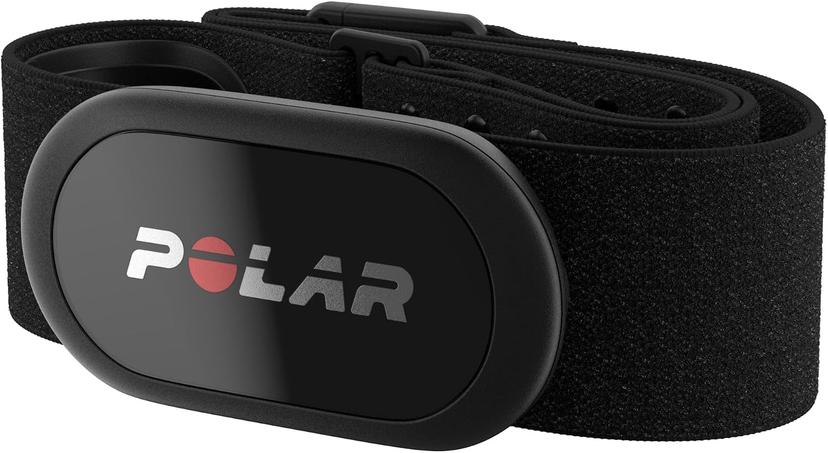
Polar H10
Chest strap with ECG, Bluetooth, ANT+ and GymLink, a replaceable battery rated up to 400 hours and internal memory for one session.
Pros
- •Heart rate and RR intervals validated against ECG in several published studies, with agreement within a few milliseconds at rest and during moderate effort.
- •Replaceable CR2025 coin cell rated by Polar at up to 400 hours: no cable, no charger and no subscription fee.
- •Connects over Bluetooth, ANT+ and GymLink, with two simultaneous Bluetooth connections, so it works with watches, apps and gym machines.
- •Internal memory for one session of up to 30 hours, useful if your phone or watch fails mid-workout.
Cons
- •It is not a standalone device: without a compatible watch, phone or app it shows nothing, and the analysis (HRV, sleep, recovery) depends on the app you choose.
- •An elastic chest strap is less comfortable than a wrist device for everyday use and for sleeping, and the electrodes need moistening before each use.
- •The published studies involve healthy adults in the lab: they show nothing about arrhythmias or other conditions, and Polar does not present it as a medical device.
- •In a test with synthetic signals, its RR intervals were the slowest of the four straps compared (about 2.6 seconds), and its heart rate took a few seconds to reflect sudden changes.
What it measures and how
The fundamental difference from a watch is the method. A watch or a ring estimates your pulse with an optical sensor (photoplethysmography, PPG) that looks at how the light reflected by your skin changes with each heartbeat. The H10 uses two electrodes on the sternum and records the heart's electrical activity, much like an electrocardiogram. From that signal it detects each beat and calculates the interval between one beat and the next (RR interval), which is the raw material of HRV.
This has two practical consequences. First, the electrical signal is less sensitive than the optical one to wrist movement; Apple's support page on optical sensors, for example, cites cold, skin perfusion, tattoos or irregular motion as causes of inconsistent readings. Second, what reaches the app is heart rate and RR intervals, not a "medical ECG reading". The H10 transmits heart rate and, over Bluetooth, beat-to-beat intervals; according to Polar's manual, the module's accelerometer is only available through its SDK, that is, for developers and apps that integrate it. We have found no indication from Polar that the H10 is a medical device: it should be treated as a sports and wellness accessory, not as an instrument to detect or rule out disease.
Verified specifications
This data comes from the Polar H10 page on polar.com and its user manual (technical specifications).
- Battery: CR2025 coin cell, non-rechargeable and replaceable. Polar states up to 400 hours, which its product page equates to roughly a year of one-hour daily workouts.
- Connectivity: Bluetooth Low Energy, ANT+ (version 2.1 according to the product page) and GymLink at 5 kHz, the latter for heart rate only. It supports two simultaneous Bluetooth connections. Stated transmission range: 90 metres.
- Internal memory: one session of up to 30 hours.
- Water resistance: WR30, that is, 30 metres according to Polar. We could not verify in the documentation we consulted whether the strap transmits heart rate underwater over Bluetooth; check Polar's manual before buying it for swimming.
- Size and weight: 65 x 34 x 10 mm; 60 g with the strap and 21 g for the module alone.
- Operating temperature: -10 to +50 °C.
- Strap: Polar Pro textile, washable. Polar sells the set in two sizes: XS-S (strap 60 to 68 cm, for chests of 62 to 82 cm) and M-XXL (strap 68 to 87 cm, for chests of 71 to 118 cm). A Soft Strap is also available separately.
- Firmware: updatable.
- In the box: the sensor and the Polar Pro strap. No USB cable (it doesn't need one).
Compatibility. Polar's product page lists as compatible its Unite, Ignite 2 and 3, Vantage M3 and V3, Pacer and Pacer Pro, Grit X2 and Street X watches, as well as the Polar Flow app, and says it can be used with products from other brands. The practical rule is simple: any device that accepts a Bluetooth or ANT+ heart rate sensor should be able to connect; what you need to check is what your watch supports. Apple, for example, explains in its support documentation that the Apple Watch can pair with Bluetooth chest straps when the wrist sensor gives inconsistent readings.
What we could not verify: exactly how the session saved in the internal memory is retrieved (which app or procedure), how many users can pair it with the same device, and exactly how the H10 behaves underwater. We do not give those details because we could not check them in Polar's documentation.
Accuracy: what the studies say
This is the H10's reason for being. These are the studies we found on PubMed, with their limits, ordered from the simplest (heart rate) to the most demanding (HRV and movement).
Heart rate
A 2026 study in Sensors (Chung and colleagues, Inserm and École Normale Supérieure) compared the H10 with a reference ECG system in five-minute lab tasks and found a correlation above 0.99 in individual heart rate, both aggregated and beat by beat. It is a study with pairs of participants watching audiovisual stimuli, that is, with very little movement; the authors present it as a replication of earlier validations. It says a lot about resting conditions and little about a sprint.
RR intervals and HRV
- High intensity. Gilgen-Ammann and colleagues (2019, European Journal of Applied Physiology), of the Swiss Federal Institute of Sport, had ten healthy adults do five activities from low to high intensity with the H10 and a clinical Holter. They checked both against visual inspection of the raw ECG: RR signal quality was 99.6% for the H10 and 94.6% for the Holter, and in the high-intensity activities it dropped to 99.4% and 89.8%. The authors suggest that a strap like the H10 could be recommended as a reference for assessing RR intervals when there is a lot of movement. It is a small sample of healthy adults.
- HRV at rest and during a cycling ramp. Schaffarczyk and colleagues (2022, Sensors) compared the H10 with a 12-lead ECG in 25 people, at rest and during a cycling ramp to exhaustion. Correlations were high (above 0.93 during exertion) and the bias in RR and heart rate was minimal. The nuance matters: for a non-linear HRV index (DFA a1, used to estimate thresholds), the bias and limits of agreement widen at high intensities, and the authors warn about it. In other words, the strap is reliable for "classic" HRV and less so for advanced metrics during hard effort.
- Resting HRV and autonomic tests. Blalock, Riemann and Flatt (2026, Autonomic Neuroscience) compared the H10 with ECG in 43 healthy adults aged 18 to 39, in an eight-minute protocol (lying at rest, deep breathing and standing up). For time-domain HRV (including RMSSD, the metric almost all recovery apps use) and for cardiovagal reflex tests, agreement was excellent: concordance ≥ 0.99, mean absolute percentage error below 1% and limits of agreement of at most -1.5 to 1.7 ms. The authors conclude that the H10 is practically interchangeable with laboratory ECG in healthy young adults.
- Clinical setting. Yang and Ben-Menachem (2024, Journal of Clinical Monitoring and Computing) measured 23 patients for five minutes before major abdominal surgery, with a Holter and the H10 at the same time, and found substantial agreement in the RR interval and several HRV indices. It is a useful data point, not an invitation to use it as a medical device: the study itself is exploratory, with 23 patients.
Unconventional movement
A 2025 study in Sensors (Lindsey and colleagues) compared three commercial straps with a multi-lead ECG during a treadmill walk, a circuit and an obstacle course. More data were rejected in the circuit and the obstacle course than on the treadmill, and the H10 had a lower mean rejection rate than the Zephyr, a significant difference. The cautious reading: torso movement degrades the signal of any strap, and the H10 did better than one of its rivals, but it is not free of the problem.
Latency: the lesser-known limit
A 2025 study in Physiological Measurement (Sabioni and colleagues, KTH Stockholm) evaluated four Bluetooth straps with synthetic ECG signals, among them the H10 and the Garmin HRM-Dual. RR interval latency was about 2.6 seconds for the H10 versus 0.7 for the Garmin HRM-Dual (0.4 for the Movesense and 2.1 for the Wahoo). For heart rate, all the straps underestimated peaks and overestimated troughs, with latencies between 1 and 3.3 s depending on the device; the H10 took 2.3 s in the intermittent test. The authors attribute the differences to the digital filters each manufacturer applies when calculating heart rate, and their general advice is to rely on beat-by-beat RR intervals in workouts with abrupt changes (high-intensity intervals). That advice does not make the H10 fast: it also lagged the Garmin HRM-Dual and the Movesense in RR intervals, and its RR latency was the highest of the four.
This does not invalidate the H10, but it qualifies its reputation: the accuracy of the signal is excellent, while how quickly it follows a sprint depends on processing, and here the H10's RR intervals were the slowest of the straps tested, and its heart rate landed in the middle. It is a test with synthetic signals rather than people, and we don't know which firmware was tested.
What the studies don't cover
- Population. All the studies cited involve healthy adults, mostly young, and almost all in the lab. They say nothing about how it behaves with frequent arrhythmias, pacemakers, or people with a lot of chest hair or very dry skin, and they are no basis for interpreting a diagnosis.
- Reference source. In other work the H10 is the benchmark a watch is compared against. That is the case in a 2023 study in European Journal of Sport Science, which used the H10 as the heart rate reference to evaluate the Apple Watch 6, the Polar Vantage V and the Fitbit Sense, and observed accuracy that varied by activity in the last two. Using it as the benchmark in those studies is not additional validation of the H10.
- Studies with commercial ties. The evidence on the H10 and sleep (the sleep² app, which estimates stages from HRV) comes from a study whose authors are linked to the app's company; we discuss it, with its caveats, in the article on sleep² and Polar H10.
How long it lasts and what it costs to keep
The H10's economics are those of a coin cell. With Polar's figure (up to 400 hours), someone who trains one hour a day would use one battery a year, according to Polar itself. Replacing it is cheap and there is no subscription fee: the H10 has none, and the apps that use its data are another matter. Third-party apps may have their own terms: sleep², for example, has its own payment model, which we detail in the article linked below.
There are two usage costs to keep in mind, both cited by Polar. First, the strap needs its electrodes moistened before each use. Second, after each session you should detach the module from the strap and rinse the strap, because moisture and sweat keep the electrodes active and shorten battery life. Polar also recommends washing the strap regularly at 40 °C. If you often forget to detach the module, real-world battery life will be shorter than stated.
Who it is for and who it isn't
Yes, if you train with intervals or short sets. The electrical signal from the chest is less affected by wrist knocks and by cadence, although the H10 responds more slowly than other straps to sudden changes in RR intervals (see the latency study above). The Garmin Forerunner 965 analysis sums it up well: the wrist is fine for almost everything, but if you do very short sets and every beat matters, a chest strap is still more reliable. The same goes for the Coros Pace 4, where our analysis notes that anyone who needs accurate data in short, very intense intervals usually turns to a chest strap, and the third-party listing indicates Bluetooth without ANT+: the strap would connect over Bluetooth, something worth confirming in Coros's manual.
Yes, if you measure resting HRV in the morning. This is the use where the evidence is strongest (Blalock and colleagues, 2026). With an app that reads RR intervals, the strap replaces an optical sensor to good effect for a measurement of a few minutes lying still. Watches and rings measure HRV overnight and average it, which is more convenient but not the same as an ECG reading; in fact, in a 2025 study of nocturnal HRV and heart rate in consumer devices, which we cover in the Whoop 5.0 analysis, the H10 served as the reference to evaluate Whoop, Oura and others.
Yes, if you already have a watch and want to improve its data. A strap complements a watch without replacing it. That is the case with the Apple Watch Ultra 3: in the OutdoorGearLab test covered in our analysis, its heart rate was on average within ±1 bpm of an H10 strap, with readings that can slip during abrupt changes in intensity. If your watch is already accurate for your kind of training, the strap adds little.
Yes, with caveats, if you want to track sleep. The H10 can feed apps such as sleep², but you have to weigh sleeping with a strap on your chest. The evidence on this is limited and comes from authors linked to the company; it is in the article linked above.
No, if you want a single device that does it all. The H10 doesn't track steps, doesn't score sleep and doesn't calculate recovery. For that you need a watch, a ring or a band such as the Whoop 5.0, whose membership already includes the app. None of those scores is a diagnosis.
No, if the strap is uncomfortable for you or your skin is very sensitive. We have not reviewed a large enough sample of user opinions to cite, so we give no comfort data. What Polar does document is that the strap fits snugly on the chest and needs moist electrodes, which doesn't suit everyone or every use.
Compared with the alternatives
Versus a watch's optical sensor. The watch wins on comfort and on all-day data (sleep, steps, stress); the strap wins on reliability when movement or intensity changes fast and on resting HRV. A reasonable combination is the watch for day-to-day and the strap for sets and specific measurements. If you train at a steady pace and your watch already agrees with the strap in your case, buying it improves nothing.
Versus the Garmin HRM 600. This is Garmin's alternative, and the clearest difference is in power: according to Garmin's manual, the HRM 600 has a rechargeable lithium-ion battery with up to two months of use at one hour a day and 5 ATM water resistance, whereas the H10 uses a replaceable battery that lasts much longer. We could not verify on Garmin's website either its internal memory or its weight, and we have not found independent validation studies of the HRM 600 equivalent to those of the H10; so we cannot say which is more accurate. One caveat: the 2025 latency study included the Garmin HRM-Dual (an earlier Garmin model), not the HRM 600. If your ecosystem is Garmin and you want added metrics within Garmin Connect, the HRM 600 makes sense; if you want the sensor with the most published studies, the H10.
Versus other cheap straps. A 2025 study in International Journal of Sports Physiology and Performance examined the low-cost Coospo H808S strap against the H10, and its title speaks of "limited validity". We have not read the full paper, so we give no figures: it suggests that a cheaper strap is not necessarily equivalent, but it doesn't allow generalising to every brand.
Versus an optical arm sensor (Polar Verity Sense). It goes on the arm, not the chest, and it is optical. In the article on sleep², with the same app, accuracy was almost identical to that of the H10. For heart rate and HRV during exertion we have not found a comparative study between the two.
How we score it
Our score weighs, in this order, the accuracy of what it measures, software and subscription, battery life, comfort and value for money. The H10 scores very well on accuracy (several studies, with well-described limits), has no subscription and offers months of battery life. It loses points because it is not standalone (it depends on another device and an app), because of the comfort of a chest strap and because of the latency of its signals shown by the 2025 study. We give it 85: well short of the 90 reserved for the exceptional, because its scope is narrow.
Verdict
The Polar H10 is the logical buy for anyone who needs reliable heart rate during intervals or a resting HRV that can be checked against the literature, and who already has (or will have) a watch or an app that uses it. It is not a purchase for anyone looking for information about their sleep or recovery without doing anything else: for that, the site analyses watches and rings that do track the whole day. And, like any consumer strap, it can't diagnose arrhythmias and doesn't replace a medical electrocardiogram: if you have any symptoms, see a doctor.
Veredicto Final del Experto
Polar H10
Anyone who trains with short sets or intervals, or measures HRV in the morning, and wants a signal backed by published studies, with no subscription and a battery that lasts months.
Garmin HRM 600
Anyone living in the Garmin ecosystem who prefers a rechargeable battery of up to two months, accepting that we have not found independent studies of this model.
Skip it if…
You want a single device that tracks sleep, steps and recovery, or the chest strap is uncomfortable for you: a watch or a ring is a better fit.


