In this article
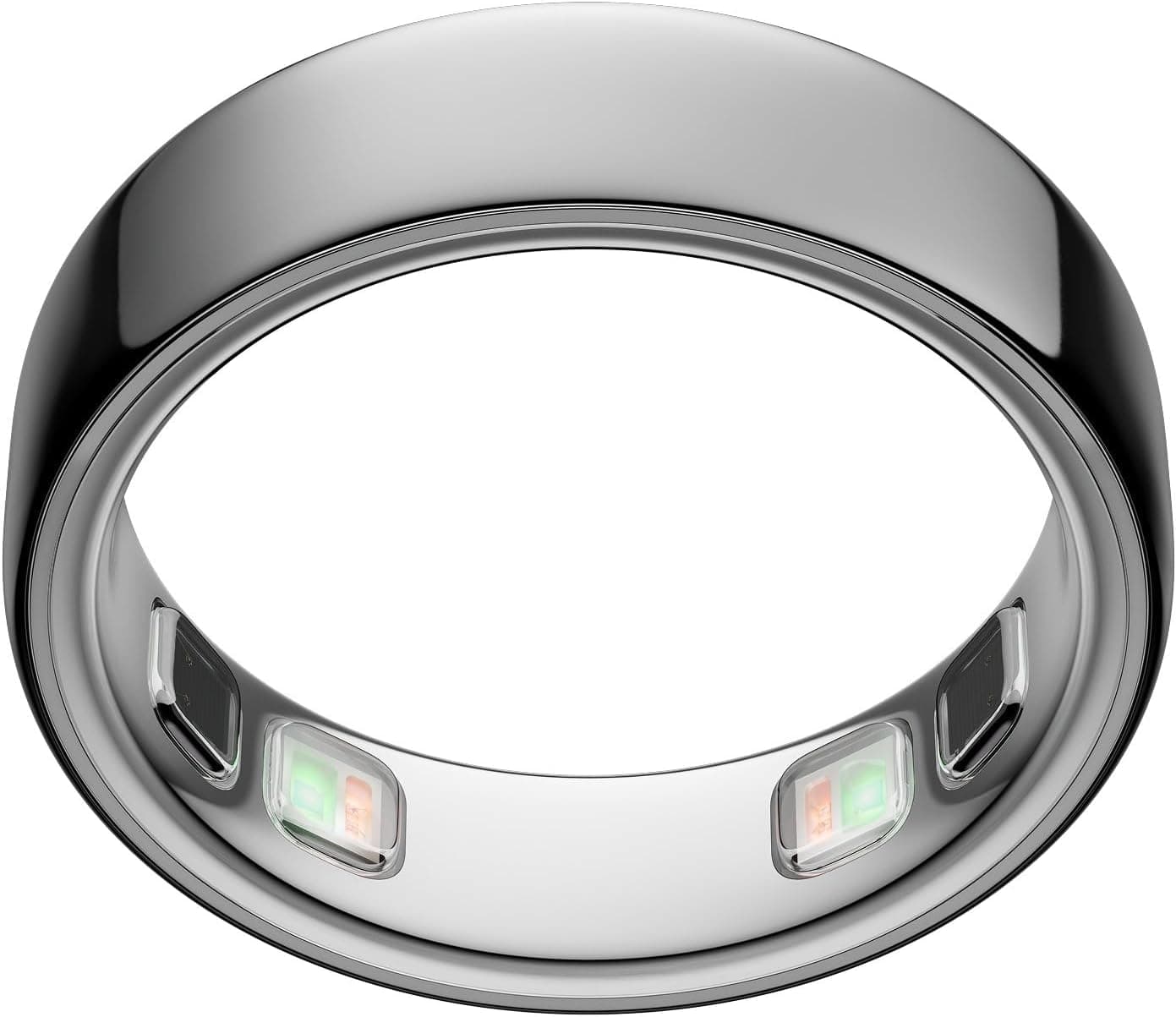
The Samsung Galaxy Ring is a smart ring without a screen that records heart rate, sleep, skin temperature and activity, and summarizes them in a daily energy score inside the Samsung Health app. Its main selling point against the Oura Ring 4 is financial: Samsung does not charge a membership to use those features. Its main condition is technical: it only pairs with Android phones.
This review is based on Samsung's official product page, published studies and what users and specialist media report. It is not based on physically testing the product. A consumer ring is useful for observing trends in your own body; it is not a medical device and does not diagnose anything.

Samsung Galaxy Ring
Screenless titanium ring that measures sleep, heart rate and skin temperature, with no monthly fee and for Android only.
Pros
- •No subscription: Samsung's official page mentions no paid subscription for the ring's features.
- •Very light: between 2.3 g (size 5) and 3.0 g (sizes 12 and 13), 7 mm wide and 2.6 mm thick, according to Samsung.
- •Official battery life of up to 6 days (sizes 5 to 11) and up to 7 days (sizes 12 and 13), with a charging case that shows the battery level.
- •Free sizing kit with 9 sample rings, sizes 5 to 13, and 10 ATM and IP68 water resistance according to Samsung.
Cons
- •Only works with Android phones (the Spanish product page states Android 11 or later); there is no official iPhone compatibility.
- •No published studies have been found that validate its sleep, HRV or temperature readings.
- •There are user reports of sharp battery loss and a high-profile case of a swollen battery, with no confirmed cause.
- •Features such as Double Pinch or Find My Ring require a Samsung Galaxy phone, and the titanium only covers the frame.
What the Galaxy Ring measures and how reliable it is
According to the official product page, the ring has an accelerometer, an optical biosignal sensor for heart rate and a skin temperature sensor. With them, Samsung Health offers:
- Continuous heart rate, with alerts if it is too high or too low.
- Sleep: stages, pattern, movement during the night, nighttime skin temperature, and heart rate and heart rate variability (HRV) during sleep.
- Energy Score: a daily score based on sleep, activity and heart rate patterns.
- Menstrual cycle tracking based on skin temperature, using Natural Cycles technology.
- Wellness tips and Sleep Coaching, which according to Samsung needs at least 7 days of sleep data.
- Automatic logging of walks and runs.
The product page we consulted does not detail blood oxygen saturation (SpO2) or respiratory rate, so they are not given here as features. If they matter to you, confirm them on Samsung's website before buying.
What has been published and what has not
This is the weakest part of the product, and it is worth saying plainly: in the search carried out for this review, no study was found that validates the Galaxy Ring's sleep stages, HRV or temperature against polysomnography or electrocardiography. The validation published for rings mostly concerns the Oura and generations earlier than the current one; as the Oura Ring 4 review explains, that model does not yet have its own independent validation either. The difference is one of degree: for the Oura, accuracy is plausible given the track record of its earlier generations, whereas for the Galaxy Ring no reference has been found.
Some useful context is a validation of six consumer devices against polysomnography, which did not include the Galaxy Ring. It concluded that the devices were valid for estimating sleep timing and duration in healthy adults, but that all of them needed to improve at identifying specific sleep stages. It is reasonable to expect similar behavior from any ring with optical sensors: more reliable for telling when you sleep than for saying how many minutes of deep sleep you had.
There is a practical consequence. A ring without published studies is not a ring that measures badly; it is a ring whose accuracy cannot be asserted with third-party data. That is why the Energy Score and the sleep stages should be read as guidance relative to your own baseline, not as an exact measurement. This gap weighs on the score, which ends up below the Oura Ring 4's.
Temperature and cycle
The temperature the ring measures is that of the skin on the finger during the night, not core body temperature. It is useful for spotting deviations from your own pattern, and Samsung uses it to estimate the menstrual cycle with Natural Cycles. It is not a clinical thermometer or a tool for detecting illness, and Samsung does not present it as one.
Compatibility: the point that decides the purchase
The wording of the requirements changes by country. Samsung's Spanish product page states a phone with Android 11 or later, without mentioning the brand, while the US page talks about a compatible Samsung Galaxy phone. Specialist media have cited pairing with Android phones from other brands, but this is not something Samsung guarantees in writing in every market. Before buying, check on Samsung's website for your country that your exact model is listed as compatible.
Some features do require a Galaxy. According to the official Spanish page:
- Double Pinch (the pinch gesture to control the camera or dismiss alarms) only works with Samsung Galaxy phones running One UI 6.1.1 or later.
- Find My Ring is only compatible with Samsung Find, which runs on Galaxy devices, and shows the last pairing location, not real-time tracking.
According to the official product page we consulted, the health analysis features (Energy Score, wellness tips and Sleep Coaching) rely on Samsung Health; some may require a Galaxy phone depending on the country.
There is no iPhone version. The official website only mentions Android and, according to Digital Trends, the ring cannot be used with an iPhone, just like Galaxy watches; there is no official compatibility today. If you use an iPhone, this ring is not an option: that is why we do not recommend it in that case. If you are in the Apple ecosystem, the Apple Watch Ultra 3 is a wrist-worn alternative, with a different logic of use.
Battery life: the official figure and what users report
Samsung states up to 6 days on one charge for sizes 5 to 11 and up to 7 days for sizes 12 and 13, based on its tests, and clarifies that actual duration varies with use. The smaller sizes have less official battery life than the larger ones, which makes sense given the space available for the battery.
The ring is stored and charged in a transparent case whose multifunction button shows the battery level. The case can be charged wirelessly (the charger is sold separately) and its size varies with the ring size.
An independent average battery life figure could not be verified; the official ceiling is the one on the product page, and actual duration depends on size and use.
What worries more is durability. In 2025, specialist media such as Android Authority reported the case of a content creator whose ring swelled on his finger and had to be removed at a hospital. Samsung called the case "extremely rare", said it was investigating and collected the ring. That outlet considered it likely that exposure to salt water played a role, and that is its own assessment, not a confirmed conclusion. In addition, testimonies of rings going from lasting a week to lasting a day or less keep appearing on Reddit and in the Samsung forum, and some users describe replacements that repeat the problem.
These are anecdotes, not statistics, and there are no public figures on how many units are affected. Even so, it is a risk comparable to the Oura Ring 4's, which also has accumulated reports of battery degradation. It is worth keeping the receipt and checking the warranty and return conditions.
Sizes, fit and materials
Samsung offers US sizes 5 to 13, with a free kit of 9 sample rings that it recommends wearing for at least 24 hours before choosing. By comparison, the Oura covers sizes 4 to 15 and, according to its product page, weighs between 3.3 and 5.2 g. The Galaxy Ring is lighter and slightly thinner (2.6 mm versus about 2.88 mm for the Ring 4).
Two points about materials:
- Samsung specifies that the titanium only applies to the device's frame; it is not a solid titanium ring.
- Water resistance is 10 ATM, and IP68 (up to 1.5 m in fresh water for 30 minutes). Samsung warns that it is not suitable for pressurized water activities or diving.
As with any ring, fit affects reading quality: if your finger changes thickness with heat or fluid retention, a badly chosen size can produce noisier data. Users recommend trying the kit for several days, at different times of day.
Total cost compared with the Oura Ring 4
The ring's price is the one shown on the Amazon buy button, and it is not written here. What can be compared is the fee, which is the differentiating factor.
According to Oura's help center, its membership costs €5.99 per month or €69.99 per year in the European Union. With the annual fee, three years add up to about €210 on top of the device, and without it the Oura is reduced to three daily scores. For the Galaxy Ring, the official product page mentions no subscription, so the outlay is concentrated in the purchase. For Android users, that difference is the strongest reason to choose it.
The comparison is not complete without what you give up:
- Validation: earlier generations of the Oura have published studies against polysomnography (partly funded by the company, with their limits); the Ring 4 has no independent validation of its own, and no reference has been found for the Galaxy Ring.
- Ecosystem: the Oura also works with iPhone; the Galaxy Ring does not.
- App depth: Oura offers more recovery and trend analysis, but behind the fee. Samsung Health is a general-purpose app, with less focus on sleep biohacking.
Compared with other alternatives
The smart rings comparison places the Galaxy Ring alongside its rivals. In short:
- If you want a ring with a longer track record of published studies (from earlier generations) and accept a fee: Oura Ring 4.
- If you are looking for recovery and training load: the Whoop 5.0, a membership-based band focused on strain and recovery rather than on wearing something discreet at night.
- If you do strength training: a titanium ring with an exposed frame suffers with barbells and dumbbells. A sports watch measures training better.
Is there a Galaxy Ring 2?
As of today (October 29, 2026), there is no newer model on sale. Samsung has acknowledged that it is working on the next generation, with no date, in statements by its head of digital health, Hon Pak, reported by Wareable. According to ETNews, reported by Tech Advisor (May 2026), the launch will be delayed to early 2027; this is press information, not a Samsung announcement, and the expected improvements are not confirmed. For the buyer, this means the current model will remain the current one for quite some time, and waiting for a successor with no date makes little sense if you need the ring now.
Who it is not for
- iPhone users. There is no compatibility, and it is the clearest reason to rule it out.
- Anyone who needs proven reliability. Without published studies on the ring, there is no way to assert its accuracy for sleep or HRV with third-party data.
- Anyone who does strength training or contact sports. The ring is not designed for gripping barbells, and a ring's workout tracking is less reliable than a watch's.
- Anyone looking for medical data. It does not diagnose apnea, arrhythmias or diseases.
- Anyone who wants all the gesture and location features. They require a Galaxy phone.
Verdict
The Galaxy Ring is the logical choice for someone who has Android and does not want to pay a fee to see their own sleep data. It is light according to its product page, with a comfort that the HotHardware review describes as "supremely comfortable", reasonable in battery life on paper, and its total cost is clearly lower than the Oura's over the medium term. Its weak point is the lack of published studies on the ring itself and the reports of battery problems.
The score of 78 out of 100 is somewhat below the Oura Ring 4's, following the order of weights: on accuracy, the Ring 4 is plausible thanks to studies of earlier generations, while no reference has been found for the Galaxy Ring; on software and subscription, the absence of a fee largely makes up for a less specialized app; on battery life, 6-7 official days for the Galaxy Ring versus 5-8 for the Oura Ring 4, with degradation reports for both; on comfort, the HotHardware review describes the Galaxy Ring as very comfortable; and value for money is what most favors the Galaxy Ring. The Galaxy Ring's real advantage is having no fee, and the difference from the Oura is explained mainly by accuracy.
Before buying: confirm that your phone runs Android 11 or later, request the sizing kit and wear it for a full day, and keep the receipt in case battery problems arise.
Veredicto Final del Experto
Samsung Galaxy Ring
Android users who want a discreet ring for sleep and refuse to pay a monthly fee.
Oura Ring 4
Those who use an iPhone or prefer the ring with a longer track record of published studies and accept the fee.
Avoid if…
You use an iPhone, do strength training or need a ring with published studies on the model itself.