Smart Rings 2026: Oura, Galaxy Ring and Whoop
In this article
People comparing smart rings usually decide with three questions, almost always in this order: which phone they have, whether they accept paying a fee to see their own data, and how far they can trust what the device measures. The comfort of sleeping with nothing on your wrist is the reason people start looking, but those three questions are what end up tipping the purchase. A consumer ring is useful for spotting trends in your own body, not for diagnosing anything: none of the devices compared here presents itself as a medical device.
This comparison puts the Oura Ring 4 head to head with the Samsung Galaxy Ring and adds the Whoop 5.0. The Whoop is not a ring but a screenless band, yet it appears here because it is the natural alternative for anyone torn between wearing something on the finger or on the wrist who wants the same kind of data (sleep, recovery, strain) without distractions. It is based on each manufacturer's specifications, on published studies with their limits, and on what users and specialist outlets repeat; it is not based on hands-on testing of the products.
Note for buyers: the Ring 4 is now the previous generation. According to the specialist press, Oura announced the Ring 5 on May 28, 2026 and began shipping it on June 4. It is roughly 40% smaller and its stated battery life is 6 to 9 days, versus 5 to 8 for the Ring 4. The Ring 4 is still on sale and makes sense if you find good terms or if size doesn't bother you, but it is worth looking at the Ring 5 too before deciding (here is our Oura Ring 5 review). Sizes are not interchangeable between generations.
| | Oura Ring 4 | Samsung Galaxy Ring | Whoop 5.0 | | :- | :- | :- | :- | | Format | Titanium ring | Ring (titanium only in the frame) | Screenless band | | Compatibility | Also works with iPhone | Android only; does not work with iPhone. The Spanish product page says Android 11 or later and the US one says a Galaxy phone | Phone app; check on Whoop's website | | Subscription | Membership for the full app | No fee according to the official product page | Mandatory membership that includes the device | | Official battery life | 5 to 8 days (typical) | 6 days (sizes 5 to 11) or 7 days (sizes 12 and 13) | 14 days | | Published validation | Studies of earlier generations (Gen2 and Gen3); none of the Ring 4 | None found | Studies of the 3.0 and 4.0, with funding ties in some | | Where it falls short | Strength training; titanium scratches | Working with iPhone; offering studies on the ring itself | Providing a screen or its own GPS; a one-time payment |
Battery life figures are the manufacturers' own; users tend to report less.

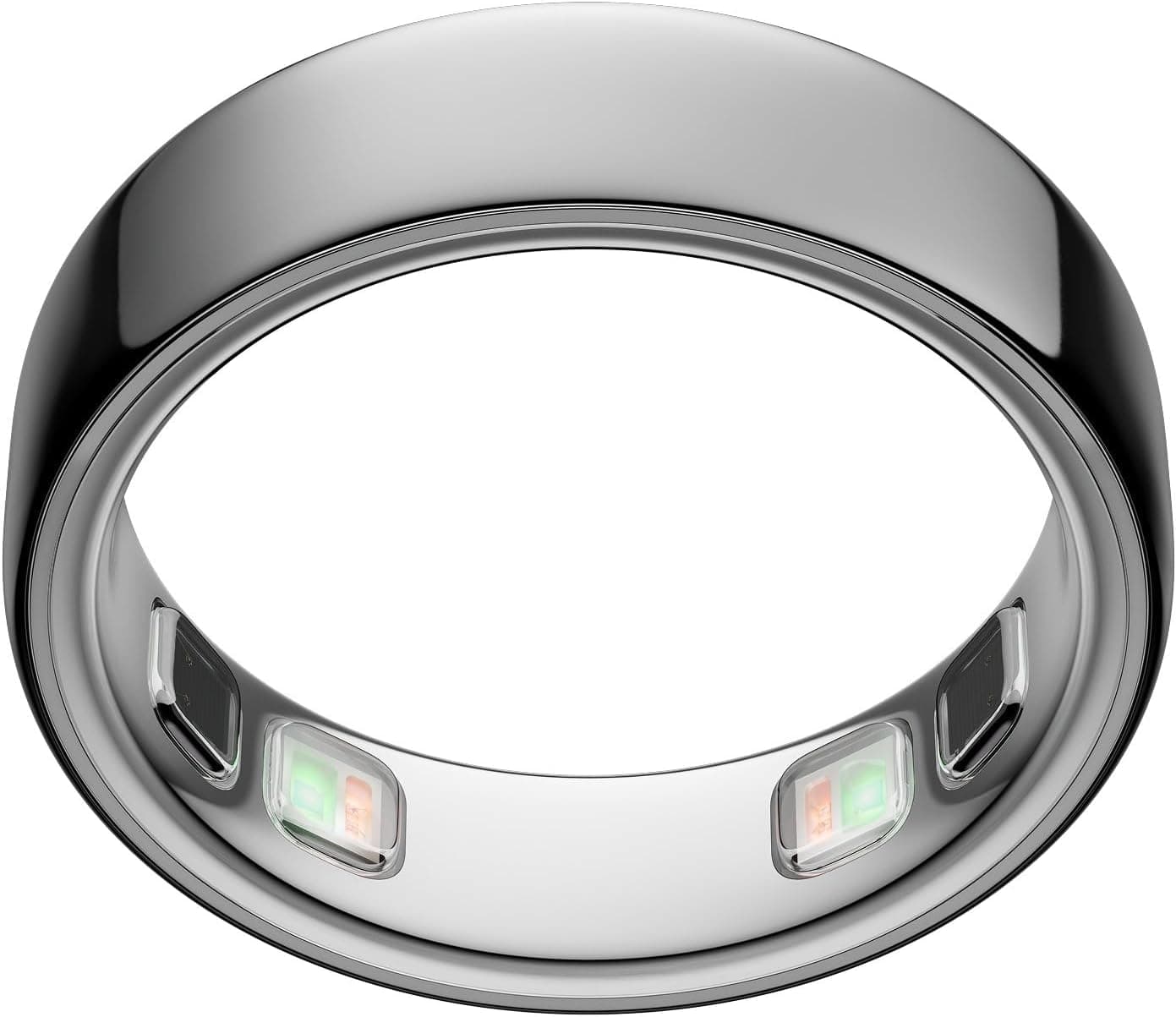
Oura Ring 4
Screenless titanium ring that tracks sleep, HRV, temperature and SpO2, with a subscription-based app.

Samsung Galaxy Ring
Screenless ring that tracks sleep, heart rate and skin temperature, with no monthly fee and Android only.

Whoop 5.0 (with membership)
A screenless band focused on recovery, strain and sleep, bought as part of a membership.
Accuracy and validation: what has been published for each
This is the criterion that weighs most and the hardest to compare, because the available evidence does not correspond to the models on sale today.
Oura. The published studies against polysomnography, the reference test in sleep laboratories, were carried out with earlier generations of the ring (Gen2 and Gen3), not with the Ring 4. A study in Sensors (2024) with the Gen3 found good discrimination between sleep and wakefulness and a per-stage sensitivity of between 76.0 and 79.5%, with a small sample, a single night, healthy participants and funding from Oura. A paper from the National University of Singapore with 58 participants and 157 nights obtained 76.4% accuracy across four stages with a Gen3 algorithm applied to modified Gen2 rings. The cautious reading is that the Ring 4 is plausibly accurate given the track record of its predecessors, but its accuracy does not, for now, have independent validation of its own.
Samsung Galaxy Ring. In the search carried out, no published study was found that validates its sleep, HRV or temperature. That does not mean it measures poorly: it means its accuracy cannot be asserted with third-party data. The difference from the Oura is one of degree. For the Oura there is a track record from earlier generations, with caveats; for the Galaxy Ring no reference was found.
Whoop. The validation studies are for the 3.0 and 4.0, not the 5.0, and in some of them there are funding ties with the company. A 2025 study in Physiological Reports with 13 healthy adults and 536 nights compared the Whoop 4.0 and several Oura rings against a chest strap: the band showed good agreement for nocturnal heart rate and HRV, somewhat below the Oura Gen 4 in that study, which the paper does not expressly identify as the Ring 4. On sleep, the 3.0 showed moderate agreement across the four stages in a 2022 study.
Two ideas keep coming up. First, in the Oura and Whoop studies, both tell sleep from wakefulness better than they distinguish light, deep and REM sleep, so the stages of any single night should be read as estimates, and what is useful is the trend over weeks; it is reasonable to expect something similar from the Galaxy Ring, although there is no data. Second, none of the three shows that using it improves your sleep; they measure, and what you do with the data is another matter. For resting heart rate and HRV, the Oura comes out somewhat better in the available literature; for the Galaxy Ring there is nothing to compare against.
Temperature and SpO2 deserve a separate note. Rings measure the temperature of the skin on the finger and its deviations from your baseline, not core body temperature; they are useful for seeing relative changes and are not a clinical thermometer. SpO2 is an indicative nighttime estimate, not a medical pulse oximeter. For the Galaxy Ring, the official product page consulted does not detail SpO2 or respiratory rate, so they are not given as data here.
Sleep: what each app offers
The Oura turns the data into three daily scores (Sleep, Readiness and Activity) and builds on them trend analysis, daytime stress and women's health. These are proprietary algorithms: Oura publishes which variables are involved, but the weighting cannot be audited, and the scores are relative to your own baseline, so the value of the ring grows with the weeks of use.
The Galaxy Ring delivers in Samsung Health the sleep stages, nighttime skin temperature, heart rate and HRV during sleep, and a daily energy score. Samsung states that Sleep Coaching needs at least 7 days of data. It is a general-purpose app, with less focus on sleep biohacking than Oura's, and menstrual cycle tracking relies on skin temperature using Natural Cycles technology.
The Whoop organizes everything into Recovery, Strain and Sleep. Its strength is less the night than the relationship between training load and recovery: Strain is calculated from heart rate throughout the day. For anyone who trains daily and wants to decide how hard to push, it is the most direct approach of the three. For anyone who only wants to observe their rest, it offers less than a ring and requires wearing something on the wrist at night, although reviews describe the band as comfortable for sleeping.
Subscription and total cost
This is where the purchase is decided for many people, and the three models are different.
- Oura: the ring is bought separately and the full app runs on a membership. According to Oura's help center, it costs €5.99 per month or €69.99 per year in the European Union. Without it you only see three daily scores, the battery level, your profile and settings, so it is not a realistic way to use it. Over several years, the fee adds up to an amount comparable to the ring itself. In reviews and forums, it is the most repeated complaint from new buyers.
- Samsung Galaxy Ring: Samsung's official product page mentions no paid subscription for the ring's features, so the outlay is concentrated in the purchase. It is its strongest argument.
- Whoop: it does not sell the device, it sells a membership that includes the device. There is no one-time purchase, and according to a thread on Whoop's official forum, when the membership ends the company stops collecting and analyzing your data. Amounts vary by region, plan and promotions, and should be checked on Whoop's website at the time of purchase. The most advanced features (ECG, blood pressure) are on the MG model and the higher plan, and the blood pressure feature is the subject of a dispute with the FDA.
The price of the device is the one shown on the Amazon buy button and is not written here. What can be said in words: over three years, the total cost of the Galaxy Ring is clearly lower than that of an Oura, and that of the Whoop depends on the plan, because the fee is the product.
Compatibility: the criterion that rules out options
- iPhone. The Oura works with iPhone. The Galaxy Ring does not: the official website only mentions Android and, according to specialist outlets, Samsung stated in 2024 that there would be no iPhone support. The Whoop is managed from a phone app, and you should confirm on its website that your model is compatible.
- Android. The Galaxy Ring is the logical option, but compatibility depends on the country: Samsung's Spanish product page indicates Android 11 or later, without mentioning the brand, and the US one refers to a compatible Samsung Galaxy phone. Before buying, check on Samsung's website for your country that your model is listed as compatible. Features such as Double Pinch or Find My Ring require a Galaxy phone.
- Integration with other devices. The Whoop can broadcast its heart rate over Bluetooth to watches, bike computers or gym machines. The Oura allows, with a membership, integration with third-party apps such as Strava.
Battery life
The official figures are these: the Oura Ring 4 states a typical battery life of 5 to 8 days; the Galaxy Ring, up to 6 days in sizes 5 to 11 and up to 7 in sizes 12 and 13; the Whoop 5.0, 14 days. These are manufacturer figures and users report less. In forums, figures of between 5 and 10 days depending on use, and sudden drops in battery life, are repeated for the Whoop.
In both rings there is also a worrying pattern: users who describe batteries that degrade until they last one or two days after a few months. For the Oura, specialist outlets have reported that the company itself acknowledged battery problems in certain Ring 4 units in the documentation preceding its IPO. For the Galaxy Ring, there was a high-profile case of a ring with a swollen battery, which Samsung called extremely rare, with no confirmed cause. These are anecdotes, not statistics, and there are no public figures on how many units are affected. They serve as a practical reason to keep the receipt and check the warranty and return conditions.
How you charge also matters. Rings are charged on a base or case, and people who wear them usually leave them for a few minutes every few days, for example in the shower. The Whoop has a wireless PowerPack that charges while the band stays on your wrist, but it comes with the Peak plan; the One plan includes the basic charger, which according to the5krunner means taking the band off for about 150 minutes. The buy button on this page links to the One bundle, so check the Amazon.es listing to see which charger it includes before buying.
Comfort, sizing and durability
Fit is critical in a ring: a loose one gives worse readings, and the finger changes thickness with heat, food or exercise. Both Oura and Samsung offer a sizing kit (sizes 4 to 15 for the former and 5 to 13 for the latter), and users recommend wearing the trial rings for several days and at different times of day.
The Galaxy Ring is lighter and somewhat thinner than the Oura Ring 4 according to both product pages, with one caveat: the titanium only covers the frame. The Oura is titanium, with a somewhat thicker Ceramic version, and plain titanium scratches; according to specialist reviews, scratches are not covered by the warranty. The Whoop avoids the finger problem and offers several ways to wear it: wrist, bicep or clothing with a pocket.
For anyone who does strength training, a ring is a poor companion: gripping barbells and dumbbells damages the finish, and a ring's workout tracking is considered less reliable than that of a watch with GPS or a band. In those cases, the Whoop with the bicep band or a sports watch such as the Garmin Forerunner 965 avoid the grip problem, although no studies measure how much the bicep band improves accuracy, and in forums there are complaints about heart rate readings during strength work and intervals. To see the differences between the three formats in more detail, the guide to smartwatch, ring or band explains when each one makes sense.
Ultrahuman Ring Air and RingConn Gen 2
Both are habitual competitors of the Oura, but they have no review of their own on the site and do not appear in the table because their specifications could not be checked on each manufacturer's website. That is why no battery, sensor or fee figures are given here for either of them. If you are considering one, check the official website for the subscription plan (if any), the stated battery life and compatibility with your phone, and hold them to the same standard applied here to the rest: published validation studies on that specific model and clear warranty terms.
Which one to choose for your profile
- If you use an iPhone, or sleep and nighttime comfort matter most to you and you accept paying: the Oura. It is the only one of the two rings that works with iPhone, and its sleep tracking has the broadest track record of studies, although from earlier generations. Accept the fee.
- If you use Android and don't want to pay a fee: the Galaxy Ring. It is the strongest reason to choose it. Accept that its accuracy has no published backing, read the scores as a relative guide, and check your phone's compatibility on Samsung's website first.
- If you do strength training, CrossFit or play contact sports: don't choose a ring. The Whoop with the bicep band or a sports watch avoid the grip problem, although no studies measure how much the bicep band improves accuracy, and in forums there are complaints about heart rate readings during strength work and intervals.
- If you train daily and want to decide based on your recovery, without a screen: the Whoop. Accept that its value depends on a membership and check the cancellation terms before paying.
- If you want no fee at all and use an iPhone: none of the three fits. A sports watch with no mandatory fee, such as the Garmin, or the Apple Watch Ultra 3 are the reasonable route, at the cost of wearing something on the wrist at night.
- If you need medical data: none of the three models compared here diagnoses apnea, arrhythmias or fever. The ECG on the Whoop MG, which is not the model compared here, has its own FDA clearance and does not replace a medical appointment. For any doubt about your health, see a healthcare professional.
Veredicto Final del Experto
Oura Ring 4
Works with iPhone and has the broadest track record of studies, although from earlier generations. Accept the fee and compare it with the Ring 5 first.
Samsung Galaxy Ring
No membership and very light, but with no published studies on the ring itself and no iPhone compatibility.
Whoop 5.0
Screenless band focused on strain and recovery, with a bicep band for grip exercises. Runs on a membership.