Smartwatch vs Smart Ring vs Fitness Tracker: Which to Pick
In this article
Choosing between a smartwatch, a smart ring and a fitness tracker comes down to four questions: which phone you have, whether you accept paying a fee to see your own data, whether what you want to measure is sleep or training, and how much you mind wearing something on your wrist at night. This guide puts them in order, format by format, and ends with a recommendation by profile, linked to the review of each device. It is based on what those reviews say, which in turn bring together manufacturer specifications, published studies and reviews from specialist media; not on hands-on testing of the products.
One warning common to all three formats: they are consumer devices. They are useful for observing trends in your own body, not for diagnosing. The few features with regulatory clearance are noted below, and if you have any health concern, the right step is to consult a healthcare professional.
The three formats at a glance
| | Smartwatch or sports watch | Smart ring | Fitness tracker (band) | | :- | :- | :- | :- | | Screen | Yes, with its own GPS | No | Varies: none (Whoop) or small (Xiaomi) | | Strong at | Outdoor training | Sleep and recovery | Training load or budget entry | | Weak at | Bulky for sleeping | Strength training | No GPS of its own | | Fee | Normally none | Oura yes, Samsung no | Whoop yes, none found for Xiaomi | | Battery | From 2 days to weeks | Up to a week or a little more | 14 to 21 stated days |
The table simplifies: within each format there are big differences, and the following sections detail them.
What each format measures and how well it is backed
All three formats use the same basic underlying technology, an optical heart rate sensor, and add, depending on the model, skin temperature, blood oxygen saturation (SpO2) and movement. What changes is the algorithm, where it is worn and the validation each device has. And there is a general warning here: almost none of the published validation corresponds to the model sold today.
A systematic review published in JMIR in 2022 on the accuracy of wrist-worn bands and watches included 65 articles and could not carry out a meta-analysis because of the heterogeneity of the studies. According to its abstract, the Apple Watch had a mean absolute percentage error below 10% for heart rate in two studies, and for energy expenditure the error exceeded 30% in all brands. The cautious reading: wrist heart rate can be reasonable depending on the device and the effort, and the calories any wearable shows are a rough estimate.
On sleep, a study published in Sensors in 2024 compared the Oura Ring Gen3, the Fitbit Sense 2 and the Apple Watch Series 8 against polysomnography in 35 healthy adults over one night. According to its abstract, all three devices detected sleep with a sensitivity of around 95% or higher (the Oura Gen3, around 95%), but by stage sensitivity was lower and uneven: 76.0 to 79.5% for the Oura Gen3, 61.7 to 78.0% for the Fitbit and 50.5 to 86.1% for the Apple Watch Series 8, which also underestimated wakefulness. It is a small sample, covering one night and healthy people, with devices that are not the current ones; the study was funded by Oura and its lead author is a medical adviser to the company. A useful rule comes out of it for all three formats: these devices detect sleep well, but wakefulness and the stages of a particular night (deep sleep, REM) are estimates; what is valuable is the trend over weeks.
By format, here is what the reviews say:
- Watches. The Apple Watch Ultra 3 is the one that brings together features with US FDA clearance: ECG, hypertension alert and sleep apnea alert (its regulatory status in the EU is not confirmed). In one specialist outlet’s test, its GPS and heart rate came out very well, while for sleep, HRV and temperature there is no published validation of this model. The Garmin Forerunner 965 offers overnight HRV and a daily readiness score; in the tests its review reports, heart rate was almost identical to a chest strap in steady running and failed in short intervals, and there is no independent validation of the readiness score. The Coros Pace 4 records HRV and sleep, also with no independent validation found.
- Rings. They have the most sleep studies, although from earlier generations: according to the Oura reviews, the published polysomnography work was done with the Gen2 and Gen3, not with the Oura Ring 4 or the Oura Ring 5, and some have funding from the company. The Samsung Galaxy Ring has no study found. Their temperature is that of the skin of the finger and is useful for seeing deviations from your own pattern; it is not a clinical thermometer.
- Bands. The Whoop 5.0 relies on studies of earlier models, not the 5.0: a 2025 study with the Whoop 4.0 found good agreement of overnight heart rate and HRV with a chest strap, and a 2022 study with the Whoop 3.0 found it with an ECG and, for sleep staging, only moderate agreement against polysomnography. In some there are funding ties to the company. The Xiaomi Smart Band 10 has no independent validation found for heart rate, SpO2 or sleep, and according to one specialist review it offers no HRV.
Sleep and night-time comfort
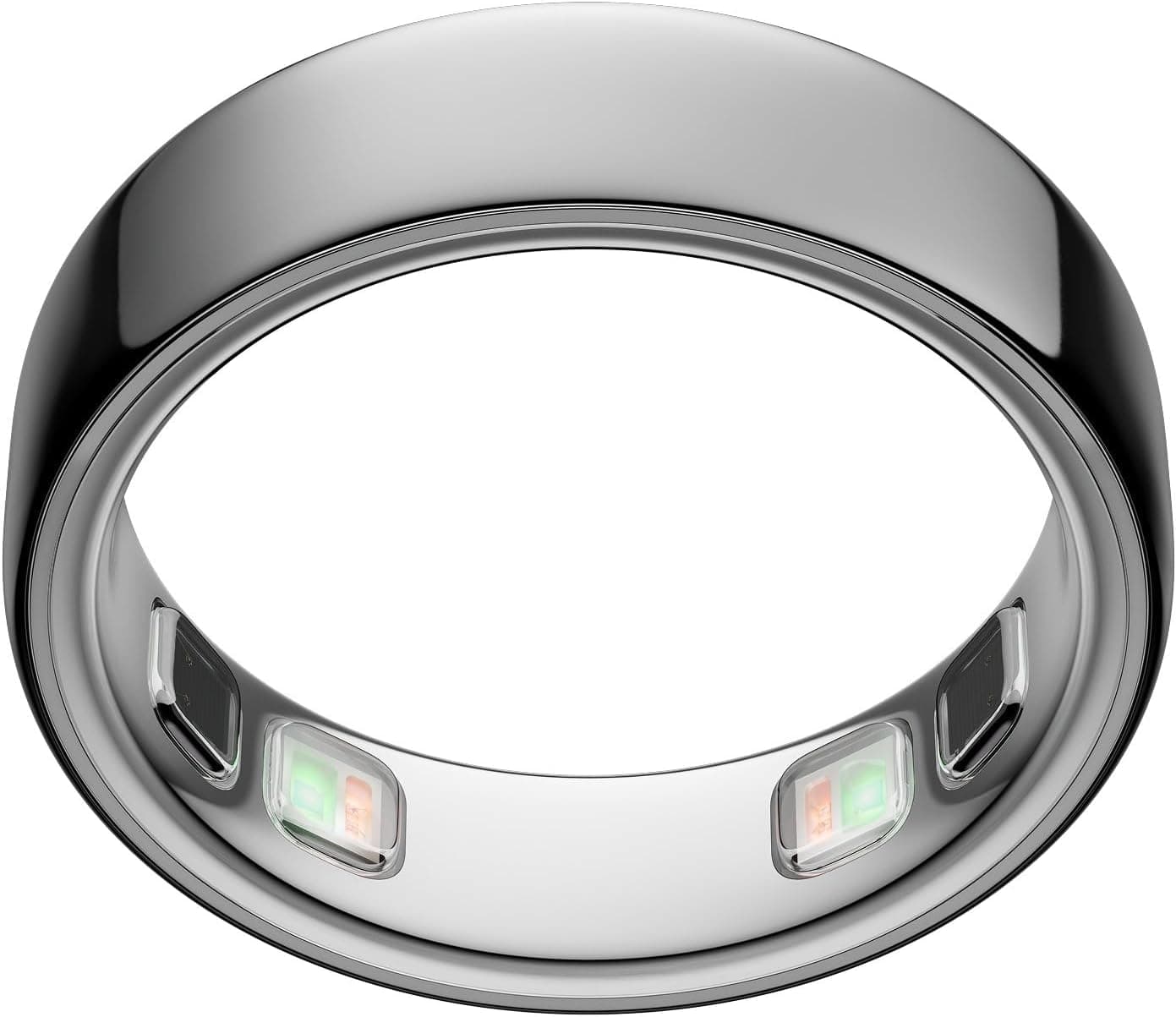
If the main goal is to measure rest, the practical criterion is what you wear at night. A ring has no screen or vibrations and, according to the reviews collected, is barely noticeable: on the Oura Ring 5, several reviews agree that it is more discreet than its predecessor, at 6.09 mm wide versus the Ring 4’s 7.9 mm. The Galaxy Ring weighs between 2.3 and 3.0 g according to Samsung.
The Whoop 5.0 weighs about 26.5 g and, according to the review, reviews consistently describe it as very comfortable for sleeping. The Xiaomi Smart Band 10 weighs a little under 16 g without the strap. Watches are the bulkiest: the Garmin Forerunner 965 measures 47 mm for the case and 53 g, and the Apple Watch Ultra 3 comes in at around 62 g with a 49 mm case. Sleeping in them is a matter of taste, and the Garmin review itself notes that this trade-off is real and that it is why many buyers end up considering a ring or a band as a complement.
There is one more detail for anyone tracking sleep with a watch: you have to wear it at night, so charging has to fit in at another time of day. With a battery lasting several days or more it is not a problem; with an Apple Watch’s, it does take some organising.
Training: where each format wins
For training, the watch wins on the basics: a screen to see effort live and its own GPS. The reviews detail it this way:
- Running, cycling and outdoor sport. A watch with multi-band GPS such as the Garmin Forerunner 965 or the Apple Watch Ultra 3 handles the route without a phone. The Coros Pace 4 also includes dual-frequency GPS in a 32 g watch with the nylon strap.
- Strength, CrossFit and grip sports. This is the weak point of rings: according to the Ring 4 review, gripping barbells and dumbbells damages the titanium finish, and one Ring 5 review describes pulse dropouts when holding weights. For these cases, the Apple Watch review recalls that a chest strap remains the reference in short sets. Whoop offers a bicep band, but its review clarifies that there is no study measuring how much it improves accuracy.
- Load and recovery without a screen. The Whoop 5.0 calculates Strain from heart rate across the whole day and cross-references it with Recovery. It is the most direct approach for anyone who trains daily and decides how hard to push based on that data.
A caution about the promise of "training by HRV": a 2021 meta-analysis on HRV-guided training, with 8 studies and 198 participants, found no significant effect on performance. The metric helps guide load, but there is no solid evidence that a device, on its own, improves your times.
Battery: from hours to weeks
The figures are those stated by each manufacturer, and tests and users report less.
- Apple Watch Ultra 3: 42 hours according to Apple; a specialist outlet measured 16 hours of continuous GPS and about two days of mixed use.
- Garmin Forerunner 965: up to 23 days in watch mode according to Garmin’s manual, and up to 31 hours of GPS; with the always-on display, battery life falls well below that.
- Coros Pace 4: up to 19 days of daily use according to Coros, and around six with the always-on display according to one review.
- Oura: 5 to 8 stated days for the Ring 4 and 6 to 9 for the Ring 5. In the Ring 5 reviews, measurements come in at around a week.
- Samsung Galaxy Ring: up to 6 days (sizes 5 to 11) or 7 (sizes 12 and 13).
- Whoop 5.0: 14 stated days; forums report between 5 and 10 depending on use. With the PowerPack it charges while worn.
- Xiaomi Smart Band 10: up to 21 days with low-demand use, and up to 8 in intensive use.
With rings there is also a risk worth knowing about: on forums there are users describing batteries that degrade over the months, and for the Galaxy Ring a widely reported case of a swollen battery was collected, which Samsung called extremely rare. These are anecdotes, not statistics, but they justify keeping the receipt and checking the warranty.
Fees: the cost that does not appear on the buy button
For many people this is where the purchase is decided, and the formats do not divide by type of device but by brand. Device prices are checked at the buy button and are not written here; fees, however, can be compared:
- Oura: the full app runs on a membership, which according to Oura’s help centre costs €5.99 a month or €69.99 a year in the European Union. Without it you only see three daily scores, the battery and little else, so it is not a realistic option.
- Whoop: it does not sell the device, it sells a membership that includes it. There is no one-off purchase, and amounts vary by region and plan.
- Samsung Galaxy Ring: the official product page mentions no paid subscription.
- Garmin and Coros: according to their reviews, the recovery and sleep features require no fee. Garmin also has an optional subscription, Connect+, which adds new features.
- Apple Watch Ultra 3: it requires no fee to see health data; possible costs are optional, such as the data plan or Fitness+.
- Xiaomi Smart Band 10: no fee appears in the sources read.
Over three years, Oura with the annual fee adds up to about €210 on top of the ring. The smart ring comparison works through that sum against the Galaxy Ring and Whoop.
Phone compatibility
- iPhone: the Apple Watch Ultra 3 works only with iPhone, and the Galaxy Ring does not work with iPhone. According to the Oura Ring 4 review, it does work with iPhone; the Xiaomi Smart Band 10 works with Android and iOS.
- Android: the Galaxy Ring is the logical choice, but the Spanish product page says Android 11 or higher without mentioning the brand and the US one speaks of a Galaxy phone; it is worth checking your model on Samsung’s website. Features such as Double Pinch or Find My Ring require a Galaxy.
- Whoop, Garmin and Coros: they work from an app on the phone. In Whoop’s case, confirm compatibility with your model on its website before buying.
What to choose for your profile
- You use an iPhone, train outdoors and want a single device for everything: the Apple Watch Ultra 3. It has accurate GPS, ECG and health alerts with FDA clearance and asks for no fee. Accept that its battery is measured in days and that it is the previous generation.
- You run or do triathlon and want up to 23 days of battery in watch mode and recovery metrics with no fee: the Garmin Forerunner 965. It is also a model older than the Forerunner 970, and its review explains when it still pays off.
- You run, want something light, with up to 19 stated days of battery and no fee: the Coros Pace 4. It has no ECG or skin temperature, nor apps or payments.
- Your priority is sleep, you want nothing on your wrist and you accept a fee: an Oura ring. The Oura Ring 5 is the brand’s most discreet; the Oura Ring 4 makes sense if you already have it or find it in good condition and the size does not bother you.
- You use Android and do not want to pay a fee: the Samsung Galaxy Ring. Accept that its accuracy has no published backing and read its scores as a relative guide.
- You train almost daily and want to decide based on your recovery, with no screen: the Whoop 5.0. The value depends on a membership you cannot get around; check the cancellation conditions first.
- It is your first wearable and you want the basics with a stated battery life of 8 to 21 days depending on use: the Xiaomi Smart Band 10. It has no GPS of its own, and according to one specialist review no HRV either, and its data has no independent validation. It is the generation before the Smart Band 11.
- You do strength training or play contact sports: do not choose a ring. A sports watch, a Whoop with a bicep band or a chest strap avoid the grip problem.
- You need medical data: none of the rings or bands reviewed diagnoses apnea, arrhythmias or fever. Of the models in this guide, only the Apple Watch Ultra 3 has ECG and alerts with US FDA clearance (the Whoop 5.0 does not include the clasp-electrode ECG, which is exclusive to the MG model; according to Whoop's press release, the ECG feature is FDA-cleared and not available in all regions; the company itself states that its blood pressure monitor is not a medical device). No wearable replaces a medical consultation.
If you are torn between two formats, combining is common: a watch for training and a ring or band for sleeping. Bear in mind that two devices add up charging, fees and data spread across different apps.
Veredicto Final del Experto
Smartwatch or sports watch
Its own GPS, screen and live metrics, with no fee on Apple, Garmin and Coros. In exchange, it is the bulkiest to sleep in.
Smart ring
Discreet and comfortable at night. Oura requires a fee and, according to the Ring 4 review, works with iPhone; the Galaxy Ring has no fee but is Android only.
Fitness tracker (band)
Whoop to decide training load with a membership; Xiaomi Smart Band 10 as an entry point with 8 to 21 stated days of battery and no GPS of its own.