In this article
Earplugs are one of the cheapest and best-selling sleep accessories, and also one of the least analyzed with proper sources: search results are full of listings, brand blogs and roundups. This piece does something different. It starts from what the manufacturer claims about one specific model, the Loop Dream, separates Loop's own data from what independent studies support, and goes over the risks that almost nobody mentions on a product page.
A note on method. The site has not physically tested the product: the analysis relies on Loop's official pages, published studies and reviews, and summaries of user opinions, which we label as such. Earplugs are not a medical device and Loop does not present them as one, and this piece promises no effect on your sleep.
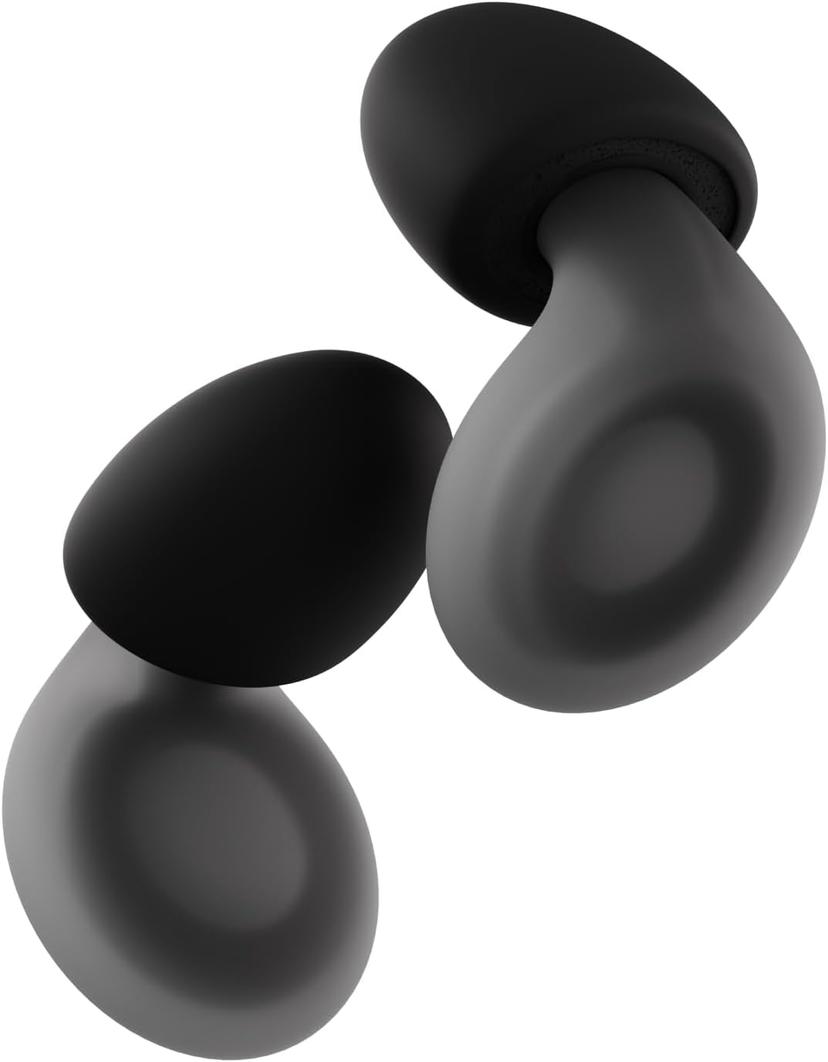
Loop Dream
Silicone earplugs with memory foam tips designed for sleeping, including on your side, with 27 dB of attenuation (SNR) according to Loop.
Why the Dream and not another Loop
Loop sells several earplug lines (Quiet 2, Engage, Experience, Switch 2). For this piece we chose the Dream because it is the one the brand presents specifically for sleep: according to its launch blog post, it is an earplug designed for sleep, with a smaller body and a thinner stem than the Loop Quiet 2, and with oval tips that follow the natural shape of the ear. The Quiet 2, for example, is also listed on Amazon.es as suitable for sleeping, with somewhat lower attenuation according to Loop (up to 26.2 dB SNR on its website); the difference the brand emphasizes for the Dream is shape and size. On Amazon.es they all show up together, so check the name on the listing before buying.
A note on the purchase link. The Dream has several listings on Amazon.es, in different colors. The link on this page goes to one of them; if color matters to you, check the selected variant before buying.
What Loop says about its earplugs
This is the data the brand publishes on its official website, and it should be read as manufacturer claims:
- Material: the tips are a combination of memory foam and silicone, according to Loop; the outer body is, in its words, "the softest silicone" they have used.
- Sizes: four tip sizes (XS, S, M and L). Each pair is sold with the M tips fitted, according to Loop's instructions page.
- Attenuation: "up to 27 dB of noise reduction (SNR)". The Dream page gives no NRR figure, unlike other models from the brand.
- Shape: oval tips, low profile and a small body, designed to reduce pressure when sleeping on your side.
- Case: its own, different from other models, with a silicone insert and a non-slip base so you can leave it on your nightstand.
- Replacement: Loop recommends changing the tips every 100 nights or uses, because the foam can lose its shape and stop sealing properly.
- Fitting: you pull the ear back and press the earplug in for about 5 seconds. Unlike other Loop models, you don't twist it.
Some Amazon.es listings also mention four pairs of "Double Tips" in the box. We did not see this on the official page we were able to read, so we do not present it as fact.
What 27 dB SNR means (and what it doesn't)
The attenuation figure is a manufacturer measurement, taken under laboratory conditions with the earplugs properly fitted. Loop itself qualifies this on its page: according to its fitting guide, the goal is an airtight seal, and the description of sounds it offers is qualitative. Quiet sounds are normally inaudible; medium-volume sounds, muffled; and loud ones, such as a siren, can still be heard at a lower volume. On snoring, Loop acknowledges that loud snoring may still be noticeable, though more muffled.
That is why the figure is useful for comparing listings with one another, but not for promising how much noise will stop being audible in your bedroom. That depends on whether the tip you choose seals well in your ear canal, and Loop devotes a good part of its guide to choosing a size and testing with your jaw. We also have not checked whether the Dream is certified as hearing protection against loud noise: the website presents it for sleep, not for machinery or concert noise.
The 91% claim: where it comes from
Loop claims that 91% of users said the Dream improved their sleep quality. It is the figure most repeated in its communications, and the fine print is worth reading: according to Loop's launch blog post, it comes from an internal user test in August 2024, with 55 participants who used the earplugs for 10 nights. The comparison group was people who previously used foam earplugs, the Loop Quiet 2 Plus or no earplugs. The post does not say who ran the test or whether it was independent, and the measure is the participants' perception, not a measurement of sleep.
That doesn't mean it is false. It means it is marketing data from a small sample, with no described control group, and it is not equivalent to a study. A figure of a different kind, 79% of users saying they feel more rested, the blog gives without saying where it comes from.
What studies say about earplugs and sleep
Great caution is called for here. We have not found any independent study of the Loop Dream or of other consumer silicone earplugs. The existing literature comes almost entirely from a different context: intensive care units (ICUs) and simulations with healthy volunteers, where noise is continuous and alarms never stop.
Cochrane review in the ICU (2015)
The Cochrane review on non-pharmacological interventions for sleep in the ICU included 30 trials with 1,569 adults. Only three trials of earplugs, eye masks or both provided data suitable for meta-analysis. In two of them (177 participants), use was associated with less delirium (relative risk 0.55; 95% confidence interval: 0.38 to 0.80), and in two others (116 participants) with about 2.2 more hours of sleep, with a very wide interval (0.41 to 3.96). The authors rated the certainty of both results as low. And they add something that is rarely cited: most of the studies that measured sleep objectively found no benefit.
We read the plain-language summary of the review, not the full text. The participants are critically ill patients with acute illness, and the trials group earplugs and eye masks together, so they do not isolate the effect of earplugs.
2021 meta-analysis (Frontiers in Psychiatry)
A systematic review with meta-analysis published in Frontiers in Psychiatry in 2021 analyzed eye masks and earplugs, alone or combined, in about 2,700 participants (35 studies, 21 of them pooled). Subjective sleep quality scores were better with the intervention, with very high heterogeneity (I² of 88.7% on one of the scales), which indicates very disparate results between studies. Of the five polysomnography studies (objective sleep data), only the three that could be pooled, run with healthy adults in a simulated ICU, allow a meta-analysis; the two run in real ICUs were not pooled because they used different scales. The authors themselves urge caution because of the simulated setting and small samples. They also cite several individual trials with no significant benefit. We read almost the full text.
One detail so as not to count twice: these two reviews share some of their studies, so they are not independent evidence of each other.
What that evidence allows us to say
With that material, what can be stated is limited: in very noisy environments, some small, low-certainty studies associated earplugs and eye masks, often used together, with better sleep measures. What cannot be stated is that silicone earplugs improve the sleep of a healthy person at home, or that the Dream does so better than a pharmacy foam plug. We have not found trials for that case. Someone who sleeps in a bedroom with noise they can't control may reason that reducing it is useful, but that is an inference, not a demonstrated result.
If light is also a problem, the evidence usually refers to earplugs and eye mask together; the MyHalos eye mask is reviewed in its own piece, with the same approach.
Risks and warnings worth knowing
An earplug worn all night, every night, is not neutral. These are the points that matter, with what we know and what we don't.
- Earwax. Loop admits in its guide that wearing earplugs often "may cause earwax buildup" and that sleeping with them every night may push wax further in, with a risk of temporary tinnitus and short-term hearing loss; it recommends softening drops or seeing a professional. We have not found trials that quantify this risk with sleep earplugs. The closest thing is the clinical guidelines on earwax, which identify hearing aid users as a higher-risk group because the device interferes with the ear's self-cleaning (AAO-HNSF guideline summarized in American Family Physician). That guideline does not mention earplugs: it is a reasonable analogy, not data on the Dream. The same source recommends not cleaning the ear with cotton swabs or objects.
- Infections. Loop also says you may be at risk of an ear infection with earplugs, especially if you don't clean them. We have not found randomized trials on earplugs and outer ear infection (otitis externa). The prudent approach is to clean them as the manufacturer indicates (mild soap and lukewarm water, dried completely) and replace the tips within the recommended period.
- Not hearing alarms or a baby. This is the most important warning. A 27 dB earplug is designed, precisely, so that you stop hearing things. Loop warns that if you need to hear alarms, you should not block out all noise. If you look after a baby or a dependent person, or rely on a smoke detector or an alarm clock, it isn't worth it.
- Pain, discharge or hearing loss. If you notice pain, discharge or muffled hearing and it doesn't improve, stop using them and consult a professional. The UK NHS advises seeing your GP if earwax symptoms haven't cleared up within 5 days.
- Pressure. An earplug that sticks out or presses is uncomfortable when sleeping on your side. Loop recommends changing size and not insisting on the M if it doesn't fit.
None of this is a reason to rule out earplugs: these are risks common to any earplug used at night, and they are reduced with hygiene and a good fit. What is a reason not to buy them "blind" is not having done that calculation first.
What users say
We have not been able to open the full reviews, so what follows is an indirect summary, with that limitation. In the summaries of Amazon.es reviews we were able to see, opinions appeared mixed: some users highlight comfort, and others think they aren't worth the cost compared with foam and that they isolate less. Other summarized reviews mention a better fit that requires placing the earplugs carefully so they don't press on the cartilage, and say that for side sleeping they are somewhat less comfortable than foam ones. A CNN Underscored review, by someone who says they have used cheap earplugs for years, concludes in its headline that they wish the Dream had come out sooner.
These are scattered opinions, from different dates and with a sample we cannot measure. The useful conclusion is the opposite of an ad's: comfort is very personal and depends on ear canal size, sleeping position and the size chosen. That is why Loop offers four sizes and a trial period on its website, a detail from the brand's store that we have not checked for purchases through Amazon.
Versus disposable foam earplugs
This is the comparison that really decides the purchase. Disposable foam earplugs, sold in boxes of dozens of pairs, are what most people use when trying earplugs for the first time.
| Criterion | Loop Dream | Disposable foam | | :- | :- | :- | | Attenuation | Up to 27 dB SNR, according to Loop | Each pack states its own SNR (manufacturer data); compare the figures | | Reusable | Yes, with tip replacement every 100 nights according to Loop | No: they are thrown away, although some are reused for a few nights | | Sizes | Four tip sizes | Varies by model; check the listing | | Side sleeping | Low profile, designed for it (according to Loop) | Depends on the model; in the user opinions we saw, they are cited as more comfortable | | Hygiene | Washable; replaceable tips | Loop describes them as porous and prone to bacteria, and advises replacing them often (a claim from a competing brand) | | Long-term cost | Initial purchase plus replacements | Ongoing replenishment, with a very low unit cost |
That table should be read carefully. The hygiene row comes from Loop, which sells the opposite; and we have not measured the real isolation of either. The only evidence we have is the figure on the pack, which comes from the manufacturer, and users' testimony that some find foam isolates more.
The practical conclusion is simple. If you have never slept with earplugs, starting with disposable foam ones costs you little and answers the main question: can I sleep with something in my ear? If the answer is yes and the pressure, or the plug popping out when you sleep on your side, bothers you, that is where the Dream comes in, which costs quite a bit more but can be reused. If the answer is no, no model, not even the most expensive, is going to change that.
Who it isn't worth it for
- Anyone who needs to hear their surroundings at night: babies, dependent people, on-call workers, or anyone who relies on an alarm clock or a detector.
- Anyone who wakes up because of light, not noise. Earplugs and light are different problems. For light, an eye mask or blackout curtains work where an earplug doesn't reach.
- Anyone with ear problems: recurrent ear infections, frequent earwax blockages, a perforated eardrum, tinnitus. Talk to a professional first.
- Anyone buying them expecting to measure or fix their sleep: an earplug measures nothing. If you want to know whether something changes, you need a wearable; in the comparison of smart rings with no subscription there are options without a subscription. Even so, comparing a night with earplugs and one without does not let you separate their effect from normal variations in sleep.
- Anyone who sleeps badly for reasons other than noise: schedules, stress, light in the morning or at night. There are other approaches for that, such as a light alarm clock like the Lumie Bodyclock Shine 300 or blue light blocking glasses, with their own (and often limited) evidence, discussed in their pieces.
What it measures, what it costs to maintain, what it lacks
- Sensors: none. It does not measure sleep or noise.
- App or software: none.
- Battery: not applicable.
- Subscription: none.
- Maintenance: cleaning with mild soap and lukewarm water, and tip replacement every 100 nights, according to Loop. It is the only recurring cost we document; spare tips are sold separately on the brand's website.
How we score this piece
Our score weighs, in this order, the accuracy of what the product promises or measures, software and subscription, battery life, comfort and value for money. An earplug has no sensors, app or battery, so the score depends mostly on what backs up its claims and on comfort. We do not quantify value for money because we do not show prices.
Result: 62 out of 100. In its favor, the manufacturer's page is detailed (material, sizes, shape, replacement, fitting) and acknowledges limitations: it does not promise to eliminate snoring and it warns of the risk of earwax and infection. Against it, the attenuation and the 91% figure are brand data with no independent verification; there are no studies of the Dream or of consumer silicone earplugs; real comfort is very variable, according to the opinions we were able to summarize; and there is a maintenance cost in tips. The score would rise with an independent measurement of attenuation and with trials in healthy people sleeping at home.
Pros
- •It is the model Loop presents specifically for sleep: low profile, small body and oval tips designed for side sleeping, according to the brand.
- •Four tip sizes (XS to L) and its own case; the page explains how to choose a size and fit them.
- •Attenuation of up to 27 dB SNR according to Loop, with an honest qualitative description (loud snoring can still be noticed).
- •Reusable with replacement tips, with no app or fee.
Cons
- •The attenuation and the 91% of users figure are manufacturer data; there is no independent measurement or studies of the Dream.
- •The evidence on earplugs and sleep comes from ICUs and simulations, with low certainty, and cannot be extrapolated to a normal bedroom.
- •You won't hear alarms or a baby; risk of earwax and ear infection with nightly use if they aren't cleaned and the tips replaced.
- •Divided opinions on comfort and isolation compared with foam, and a recurring cost of replacements every 100 nights.
Verdict
The Loop Dream is a reasonable option for someone who already knows they sleep better with something in their ears and complains about the pressure of foam, especially when sleeping on their side. It is a purchase for comfort and reusability, not for a demonstrated advantage in isolation. For anyone who has never tried earplugs, the sensible move is to start with disposable foam ones.
Veredicto Final del Experto
Loop Dream
Side sleepers with noise they cannot control (a snoring partner, the street) who have already found they tolerate earplugs, but not the pressure of foam.
Disposable foam earplugs
To get started without investing: they answer the question of whether you can tolerate sleeping with earplugs. Compare the SNR on the pack, which is manufacturer data.
Avoid if…
You need to hear alarms or a baby, you have frequent ear infections or earwax, or you expect earplugs to fix a sleep problem that is not noise.
What we could not verify
- The exact contents of the linked Amazon.es listing (seller and available color variants): not given as fact.
- Whether the box includes "Double Tips" (Amazon listings say so, the Loop website we could read does not).
- The Dream's real attenuation and its certification as hearing protection: there is only the manufacturer's figure.
- Full Amazon.es reviews and the CNN Underscored review: we have only seen summaries and headlines.
- Loop's return conditions (100 days in its store) when buying through Amazon.
- Full texts: Cochrane (plain-language summary) and the clinical earwax guideline (summary in American Family Physician).
Main sources
- Loop: Dream launch blog post, Dream instructions and FAQ page and guide to earplugs for sleeping.
- Cochrane review on non-pharmacological interventions for sleep in the ICU.
- Meta-analysis of earplugs and eye masks, Frontiers in Psychiatry 2021.
- AAO-HNSF guideline on earwax, summarized in American Family Physician and NHS: earwax build-up.